


Financial services content marketing can look successful right up until the reader stops trusting it.
The page ranks. The traffic shows up. The article says the safe things in the safe order. Then the reader hits a vague claim, a thin source, a too-confident recommendation, or a generic explanation they’ve already seen five times, and the whole thing starts to feel less like guidance and more like content production.
That’s the problem with treating finance content like ordinary SEO writing. The work isn’t just getting found. It’s earning enough confidence that a cautious reader keeps going.
What makes financial services content marketing different
Financial services content marketing is the strategy of creating useful, search-visible content for audiences evaluating financial products, services, decisions, or institutions. It differs from general content marketing because the reader’s stakes are higher: a weak claim can affect trust, compliance exposure, and a prospect’s willingness to keep engaging.
A reader comparing banking options, researching credit, evaluating insurance, or trying to understand a fintech product isn’t reading with the same mindset as someone shopping for a new desk chair. They’re looking for clarity, but they’re also looking for reasons to believe or doubt what they’re reading.
That changes the work.
Financial content still needs search strategy, keyword alignment, and clear structure. But it also needs stronger source discipline, tighter claim handling, and a review process that can catch risk before it becomes public copy. If your usual workflow is “brief it, draft it, edit it, publish it,” finance has a way of exposing every weak handoff in that chain.
Financial topics need stronger trust signals because Google gives extra weight to strong E-E-A-T signals for content that can affect financial stability or safety — what its guidelines treat as Your Money or Your Life (YMYL) territory. E-E-A-T belongs in the quality conversation, but it shouldn’t be treated as a single specific ranking factor.
The practical takeaway: finance content isn’t ordinary SEO writing with financial keywords added. It’s content strategy under added credibility and compliance pressure.
Why financial services content marketing has to earn trust before it can convert
Financial services content has to earn trust in a category where trust is real but uneven: Edelman reports 64% global trust in financial services, but trust varies widely by market, audience, and subsector.
That matters because a cautious reader doesn’t convert just because a page answered the query. They keep reading when the explanation feels accurate, appropriately restrained, and useful for the decision in front of them.
Visibility and credibility are separate problems, and finance content has to solve both. The page has to be findable through search and credible enough that skeptical readers stay with it.
That doesn’t mean every article needs to sound like it was written by a legal department afraid of its own shadow. It means the content has to do the harder job: explain the topic clearly, show where the claims come from, avoid overstating what the evidence supports, and help the reader take a sensible next step.
Traffic opens the door. Trust decides whether the reader walks through it.
Build the strategy foundation before production starts
The most expensive finance content problems usually start before anyone writes a sentence.
If the brief doesn’t define the audience, claim boundaries, source standards, SME input, and review path, those decisions don’t disappear. They get pushed onto the writer, the editor, or the compliance reviewer later. That’s when simple planning misses turn into rewrites, delays, or a draft that can’t be approved without pulling it apart.
A strong brief should define:
- Audience: Who the piece is for and what level of financial knowledge they likely have.
- Intent: What the reader is trying to understand, compare, or decide.
- Topic risk: Whether the subject touches regulated claims, financial advice, consumer harm, or product-specific promises.
- Claim boundaries: What the article may state, what it must hedge, and what it should avoid.
- Sources: Which sources are approved, preferred, or off-limits.
- SME input: Where expert insight is needed before drafting.
- Review path: Who reviews the draft and at what stage.
- Content brief: How those decisions are captured before assignment.
SEO should support useful financial content, not replace it, because Google frames SEO as helpful when it is applied to people-first content.
Moving expensive expertise earlier in the process makes the work more efficient. An SME or compliance stakeholder can often catch a weak angle, risky claim, or missing caveat in a brief faster than in a finished draft.
Define the audience, intent, and claim boundaries
A finance article for a small business owner shouldn’t make the same assumptions as a guide for a CFO, a bank marketing leader, or an individual consumer researching credit. The audience changes the vocabulary, depth, examples, and level of explanation the article needs.
Before assignment, decide what the reader needs to do with the content. Then define the claim boundaries around that job.
If a statement sounds like advice, a guarantee, a product promise, or a legal conclusion, handle it before drafting. Don’t leave it for the writer to stumble into halfway through the article and hope the editor catches it later. Hope is not a review system.
To create a financial services content marketing strategy, use this sequence:
- Define the audience and search intent.
- Map the topic risk.
- Set claim boundaries.
- Gather approved sources.
- Get SME input on the outline.
- Define the review path.
- Assign the draft with constraints included.
Set sourcing and review expectations before assignment
A writer should know which sources count before they start. That may mean official regulatory pages, product documentation, approved internal materials, SME notes, or vetted third-party research. It also means knowing which sources your brand doesn’t want repeated.
The same goes for review. If the article needs SME review, legal review, compliance sign-off, brand review, or all of those steps, the writer and editor should know before production starts.
A clear review path doesn’t slow the work down. It prevents the quieter delay: the finished draft that gets pulled apart because the wrong people saw it too late.
Balance SEO, trust, and compliance before drafting
SEO is useful in financial content. It shows what readers are asking, which topics need coverage, and how competing pages frame the issue.
But SEO doesn’t decide what your business can responsibly say.
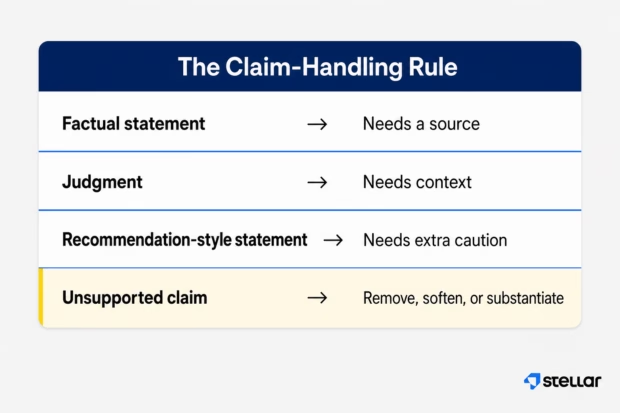
We’ve found that financial content needs a simple operating rule: separate fact from opinion, and qualify opinion with evidence where the reader would reasonably expect support.
A factual statement needs a source. A judgment needs context. A recommendation-style statement needs extra caution. An unsupported claim needs to be removed, softened, or substantiated.
Broker-dealer content may need to meet standards for fair, balanced, audience-appropriate communication. Investment adviser marketing can create risk when claims are misleading, unsupported, or not presented with fair treatment of risks and limitations.
Those examples don’t apply to every financial services business in the same way, but they show why claim discipline belongs in planning. The risky moment isn’t only publication. It’s the moment a vague SEO idea turns into copy that sounds more certain than the brand can support.
Separate fact, opinion, and unsupported claims
A useful claim-handling rule is short enough for the brief:
- Fact: Label facts as facts only when they can be supported.
- Opinion: Treat opinions as opinions, not disguised certainty.
- Substantiation: Substantiate claims that affect trust, risk, performance, cost, or decision-making.
- Prohibited claims: Remove prohibited claims before drafting.
- Disclosures: Add disclosures where the topic, format, or review team requires them.
- Legal review: Use legal review for topics that create liability exposure.
- Compliance sign-off: Get compliance sign-off where the organization’s process requires it.
- Hedging: Hedge carefully when evidence supports a point but not a sweeping conclusion.
This keeps SEO from pushing the article into overstatement. A keyword may suggest “best,” “safe,” “guaranteed,” or “top-performing,” but the content team still has to decide what the brand can responsibly say.
Use legal or compliance input at ideation and sign-off
For higher-risk financial content, bring legal or compliance in at two points: ideation and sign-off.
At ideation, the reviewer can often make a keep/kill decision from the topic, title, and angle before the team spends time building the wrong asset. They can also give direction on required hedging, disclosures, prohibited claims, or source standards.
Compliance decision rule: Use ideation review when the topic, product, audience, or claim type could create material risk. Use sign-off review when the draft is close enough to final that the reviewer can judge the actual language.
That keeps review from becoming a late-stage surprise. Nobody enjoys finding out after the draft is “done” that the angle was never viable.
Put writers, experts, and reviewers in the right roles
A good finance writer matters. You still need someone who can explain the topic clearly, organize the argument, and make the content readable.
But the writer is not the strategy. The writer is not the SME. The writer is not legal review with a keyboard.
At Stellar, we separate the writer from the strategy. Writers can turn a strong brief, approved sources, SME input, and clear constraints into useful content. They shouldn’t be expected to decide the brand’s risk tolerance, invent expert insight, choose legal boundaries, or supply authority the business itself hasn’t provided.
Role ownership should be clear:
| Role | What they own |
| Strategist | Audience, search intent, angle, content brief, and business fit |
| Writer | Clear drafting from the approved strategy, sources, and constraints |
| SME | Topic insight, accuracy checks, watch-outs, and practical nuance |
| Legal | Legal risk review where needed |
| Compliance | Organization-specific compliance requirements and sign-off where needed |
| Editor | Structure, clarity, evidence use, and claim discipline |
| Brand reviewer | Brand fit, positioning, terminology, and internal alignment |
What the writer should own
The writer should own execution. That includes turning the brief into clear prose, organizing the argument, explaining concepts from approved sources, and making the piece readable for the target audience.
The writer shouldn’t have to guess which claims are allowed, which source is authoritative, whether a statement creates risk, or what the brand’s expert perspective is. When those decisions are missing, the workflow has handed the writer strategy work without strategy authority.
That’s not a writer problem. It’s a system problem.
Some financial clients understand this clearly. We’ve had fintech clients put writers through product training before they wrote the content, and give them access to free accounts inside the tools they were covering. That’s useful because the writer isn’t just rewriting public information. They’re seeing how the product works, where the interface creates questions, and what a real user would need explained.
That doesn’t turn the writer into the product owner or the compliance reviewer. It gives the writer better inputs, which is the whole point.
Where SME input belongs
SME input is most useful after a SERP-shaped outline exists and before the draft begins. That gives the expert something concrete to react to without asking for hours of open-ended consulting.
The SME can add practical warnings, better framing, missing caveats, or brand-specific judgment. A short outline review can answer: What would a generic article miss? Which claim needs more nuance? What would a prospect misunderstand?
For a major credit card issuer we supported through an agency partner, the workflow used SME input before drafting and fact-checking after drafting. That double touchpoint mattered. The first pass helped shape what the article needed to say. The second helped verify that the finished draft had said it correctly.
That’s the before/after contrast:
| Production model | What happens |
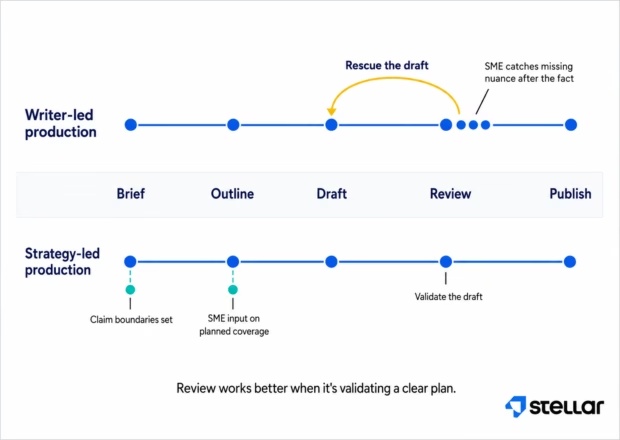
| Writer-led production | The writer receives a keyword, studies ranking pages, drafts a competent summary, and the SME catches missing nuance after the fact. |
| Strategy-led production | The team builds the outline, gets SME input on the planned coverage, gives the writer source and claim boundaries, and uses review to validate the draft rather than rescue it. |
The second version isn’t heavier for the sake of process. It moves judgment to the point where it can still shape the article.
Where legal and compliance review fits
Legal and compliance reviewers shouldn’t be used as late-stage cleanup for preventable issues. They should be involved when the topic, claims, format, audience, or product context creates risk that the content team shouldn’t judge alone.
That doesn’t mean every financial services blog post needs the same review path. A glossary-style explainer may need lighter review than an investing comparison or product-specific sales page.
Define the path before drafting so the writer, editor, SME, and reviewer aren’t working from different assumptions. The content will still need review, but review works better when it’s validating a clear plan instead of untangling avoidable confusion.
Choose topics and formats based on audience risk
Financial services topics don’t all carry the same planning burden. A basic educational guide, a banking content marketing article, a crypto explainer, a fintech comparison, and an investing piece can all sit under finance content marketing, but they don’t need the same risk controls.
Teams get better results when they choose topics and formats based on audience sophistication, product risk, compliance exposure, and trust difficulty.
The practical question isn’t only “Can this rank?” It’s “Can we make this useful, accurate, differentiated, and reviewable?”
Common types of financial services content
The topic determines how much risk the content carries. The format determines how that risk shows up. Most finance content programs draw from the same core formats, so the useful question isn’t which ones to use. It’s what each one is for in the journey, and where each one tends to fail.
| Content type | What it looks like in finance | Funnel stage | Watch-out |
| Educational explainers | How APR works, what a credit utilization ratio is, how escrow gets calculated | Awareness | Advice language sneaks in wearing an education costume. “Should you pay off your mortgage early?” is an explainer title and an advice claim. |
| Regulatory-change explainers | What a new rule means for borrowers, savers, or plan sponsors | Awareness | Goes stale on the regulator’s schedule, not yours. An outdated rule explainer is worse than no explainer. |
| Market commentary | Rate environment analysis, earnings reactions, quarterly outlooks | Awareness and retention | Drifts into predictive language fast. This format usually needs the tightest review path on the list. |
| Calculators and tools | Mortgage payoff, retirement savings, loan amortization, debt consolidation | Consideration | An unexplained default assumption is a quiet claim. Assumptions and limitations need to be visible, not buried. |
| Comparison content | Product vs. product, provider vs. provider, account type vs. account type | Consideration | Comparisons go stale in pairs. When a competitor changes a fee, your accurate page becomes inaccurate without you touching it. |
| Webinars and expert Q&As | Advisor-led planning sessions, regulation-change briefings, product walkthroughs | Consideration | These start scripted and drift off the cuff. A live answer is still a claim, so brief the speaker on claim boundaries the way you’d brief a writer. |
| Whitepapers and research | Original surveys, benchmark reports, treasury and planning guides | Consideration to decision | Unverifiable data is disqualifying here, not just weak. If the benchmark can’t be sourced, the format meant to prove authority disproves it. |
| Rate, fee, and product pages | Current rates, account comparisons, card benefit breakdowns | Decision | Stale numbers are a trust problem and sometimes a compliance one. These pages need a refresh owner, not just a publish date. |
| Testimonials and case studies | Client outcomes, advisor reviews, success stories | Decision | In advisory contexts, these can be regulated communications with disclosure requirements. Treat them as claims, not decoration. |
| Advisor and sales enablement | One-pagers, objection guides, client-ready explainers for bankers and advisors | Decision and retention | Often skips editorial review because it’s “internal.” That lasts exactly until a client forwards it. |
Formats are half the decision. The other half is the topic itself, because a budgeting explainer, a crypto guide, and an investing comparison don’t carry the same planning burden even in the same format.
Personal finance
Personal finance content is crowded and often generic. Topics like budgeting, credit scores, loans, and savings can attract search volume, but many ranking pages say similar things.
The planning burden is differentiation. Your content needs clearer audience assumptions, stronger source discipline, and a specific reason for the reader to trust your explanation over another safe summary of the same topic.
Crypto
Crypto content has a high trust hurdle. Readers may be skeptical for good reason, and weak sourcing can damage credibility quickly.
Before assigning the article, decide what the writer can cite, what sources are off-limits, what claims need hedging, and where the piece should avoid sounding like advice or promotion. This is not the category for “we’ll clean it up in editing” optimism.
Investing and stocks
Investing and stock-related content can drift into advice language quickly. Even educational content can create risk if it sounds predictive, promotional, or too confident about outcomes.
Define whether the asset is educational, comparative, product-related, or opinion-led. Then decide which claims require substantiation, hedging, or review.
Fintech
Fintech content often has two expertise layers: the financial topic and the product, tool, app, or platform experience.
Our team sees this most often when the content has to explain both a financial workflow and the technology that changes how the workflow works. Product access helps. Training helps. A writer who has actually used the platform will usually ask better questions and produce a more useful draft than one working from public positioning alone.
A fintech product comparison may need a finance SME and a product or platform expert. Banking, credit union, insurance, and wealth management topics can have similar format-specific issues.
Social content, testimonials, endorsements, or influencer-style assets may also need clear disclosures and oversight when those formats are part of the plan.
The point isn’t to make every topic harder. It’s to match the planning burden to the risk.
Differentiate financial content with evidence and brand expertise
A lot of financial content is accurate and still forgettable. Much like healthcare content, it defines the topic, repeats the common advice, adds a few safe caveats, and leaves the reader with nothing they couldn’t have found on the next ranking page.
That’s usually not because the writer failed to write clean sentences. It’s because the system didn’t give the writer anything sharper to work with.
Finance content marketing becomes more useful when evidence and expertise change the reader’s decision. A source should support a claim that matters. An SME note should add nuance a generic article would miss. A brand perspective should clarify a tradeoff, constraint, warning, or better way to frame the topic.
Add expert context, not just expert review
Expert review catches errors. Expert context improves the article before errors appear.
A useful SME contribution might be a caveat about when a rule of thumb breaks down, a warning about a common misunderstanding, or a sharper distinction between two similar options.
That kind of input gives the writer material that can’t be pulled from a quick scan of ranking pages. It also gives the article a reason to exist beyond matching the SERP.
Use evidence where it changes trust or decisions
Evidence should earn its place. A statistic, regulatory source, or research-backed claim should help the reader decide how much weight to give a point.
If the evidence only decorates the paragraph, leave it out. If it clarifies risk, supports a claim boundary, strengthens a definition, or helps the reader understand why a decision matters, use it.
Better sourcing isn’t citation clutter. It’s trust infrastructure.
Make examples specific without inventing results
Specificity doesn’t require invented case studies or unsupported outcomes. It can come from clearer before/after contrasts, practical watch-outs, better audience distinctions, product access, SME notes, or realistic process examples.
A generic article says financial brands should “build trust with educational content.” A more useful article explains which claims need support, where SME input belongs, when legal review should happen, and how the content will be judged after publication.
That’s the kind of system our content services are built to support.
Measure more than rankings and traffic
Rankings and organic traffic matter. They show whether the content is visible and whether the topic can attract demand.
But if traffic is the only thing you measure, you can miss the quieter problems: the wrong audience, weak engagement, painful review cycles, or content that attracts attention without supporting confidence.
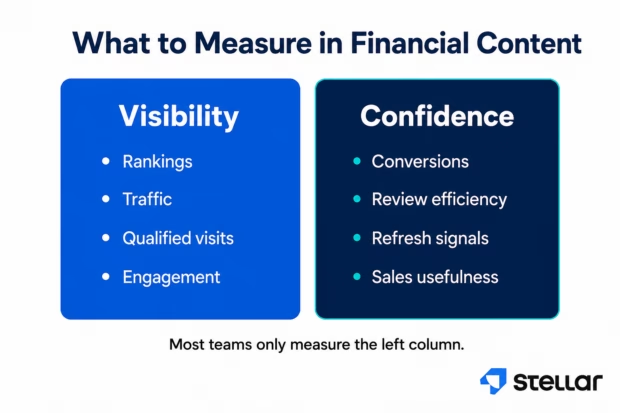
A practical measurement frame should include:
- Rankings: Whether the content is visible for the target topic and related queries.
- Traffic: Whether the page attracts enough qualified search demand to matter.
- Qualified visits: Whether the audience matches the business goal.
- Engagement: Whether readers stay, scroll, click, or continue to useful next steps.
- Conversions: Whether the content supports form fills, meeting requests, subscriptions, or assisted journeys.
- Review efficiency: Whether the content moves through SME, legal, compliance, and editorial review without repeated rework.
- Refresh signals: Whether claims, sources, product details, or regulatory context need updating.
- Sales usefulness: Whether the asset helps sales, account, or advisory teams answer real buyer questions.
A page that ranks but sends the wrong audience isn’t a great asset. A page that converts but needs painful review every time it’s refreshed may have a workflow problem. A page that supports sales conversations but brings little organic traffic may still have business value.
The best financial content programs measure both visibility and confidence. They ask whether the content can be found, whether it can be trusted, and whether it helps the reader take a next step without forcing the brand into claims it shouldn’t make.
If your team needs support with financial services content strategy, sourcing, and production workflows, you can request a meeting.