
A topic can look perfect in a content plan and fall apart the moment you search it.
The keyword has volume. The angle supports the business. Then you pull the results and the people searching those words want something you hadn’t planned to give them.
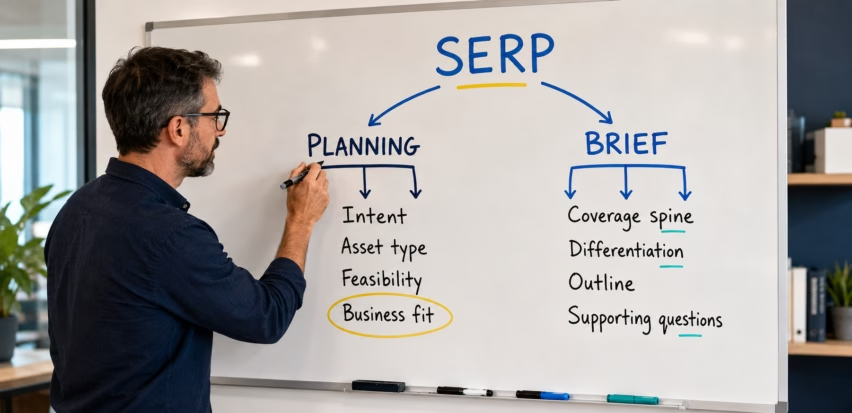
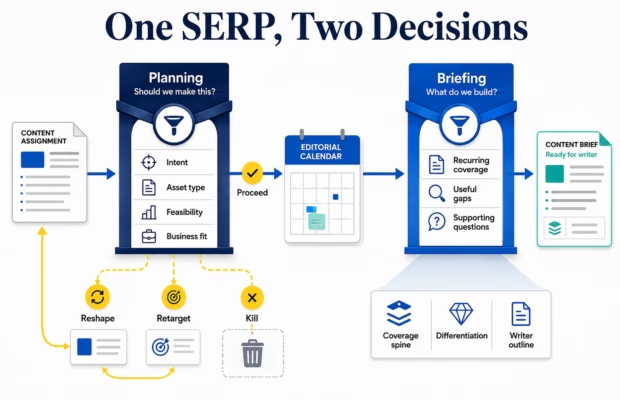
A search engine results page (SERP) analysis catches that, and it pays off at two different stages: when you’re deciding whether a topic belongs on the calendar, and again when someone builds its brief. The two runs share a method but answer different questions.
Planning asks whether to commit the slot. Briefing asks what to actually build.
Run it well at both stages and you keep weak topics off the calendar while handing writers a sharper starting point. Skip the brief-stage read because a topic “already got vetted,” and a stale planning call sails straight through to the writer.
What is a SERP analysis?
A SERP analysis evaluates the top-ranking results for a target query to determine the apparent intent, expected content or asset type, competitive landscape, and opportunities to provide something more useful.
In practice, it’s the habit of reading the current results page for a keyword and letting what you find shape the decision in front of you, whether that’s a calendar call or a brief.
What a SERP analysis should tell you
A good analysis ends with answers you can act on, not a folder of screenshots. Across the two runs, it should surface five things: search intent, the asset type the query rewards, competitive difficulty, the coverage a page needs, and where you can differentiate.
Which of those matter most depends on the stage you’re in.
| Stage | Main question | What it produces |
| Planning | Should we make this? | Intent read, asset type, feasibility, business fit, then a proceed / reshape / retarget / kill call |
| Briefing | What do we build? | Coverage spine, differentiation, and the outline the writer works from |
At planning, you’re deciding whether the topic is worth a slot, so intent, difficulty, and business fit are most meaningful. A planning-stage analysis can overturn the plan, not only approve it.
At briefing, the topic’s already approved, so coverage and differentiation take over as you turn the results into the writer’s outline.
One thing to carry into both: the results show what’s winning today, not a permanent ruling on the query. Treat them as strong evidence, and stay ready to look again if the SERP shifts. It often does.
Start with alignment: Does the topic match the SERP?
Alignment is the first gate at either stage. Before you weigh anything else, check whether the idea serves the same need as the ranking results.
Run three checks:
- User need: What’s the searcher trying to understand, decide, compare, find, or do?
- Asset type: Does the query want an article, a tool, a product page, a video, a template, or something else?
- Planned angle: Does your treatment answer the same need from a direction the results support?
The first check matters most. Shared words don’t promise a shared goal.
When the ranking results agree
In my experience, you don’t bully your way into the top ten by thinking Google might reinterpret the query for your misaligned article. When the leading results all solve roughly the same problem, treat the query as having a strong center of gravity. You can still find a fresh angle, as long as it serves that same need.
When the results are mixed
Several legitimate page types on one SERP can point to mixed intent, which gives you more than one defensible direction. It still doesn’t give you license to pick a direction the results don’t support.
Read a mixed SERP closely. A guide, a calculator, a service page, and a forum thread can all rank because the query supports several jobs at once. Pick one of those jobs deliberately, rather than averaging them into a piece that tries to serve everyone.
When the words match but the intent doesn’t
Say you’ve got a how-to scheduled. You pull the query and every ranking result is a product page or a software tool. The words match your topic, but the SERP is telling you people want to buy or use something, not read a walkthrough.
Retitling won’t close that gap. When the results overwhelmingly favor a different kind of asset, changing the article’s wording usually won’t solve the mismatch. You might need to build that asset, pick another keyword, or drop the assignment.
Settle alignment before you research anything else. There’s no point building a good brief for the wrong article.
Read what the SERP is asking for
Alignment tells you the topic belongs. The composition of the results page tells you what to build.
Classify the ranking results by what they let the reader do. A guide explains. A comparison page helps someone choose. A template hands them something to use. A calculator returns an answer. A local result points them to a nearby provider. A product or service page supports a decision to buy.
That read shapes the brief:
- When educational pages share the SERP with interactive tools, the brief might need a calculator, worksheet, or decision aid.
- When comparison pages win, plan for explicit criteria and a real side-by-side.
- When videos rank near the top, a short demonstration can do more than another 500 words.
Strong consistency across the results is a constraint worth respecting. Wide variation gives the brief more room to choose. Either way, you’re reading for the asset the query rewards, then deciding whether you can deliver it.
SERP features and AI results
The results page is more than ten blue links. Features like videos, images, featured snippets, and other rich displays change the kind of answer the brief has to support. A featured snippet rewards a compact definition or a tight process. Repeated People Also Ask questions surface clarifications the top results handle poorly. A local pack shifts the job toward location-aware evaluation.
AI Overviews and AI Mode show up here too. If you’re wondering whether they need separate handling, Google says the same foundational SEO practices apply to its AI search features. There’s no special schema or shortcut for them. Read them as one more signal about how clearly the topic needs to be explained. They also hint at coverage, since the subtopics Google pulls into its summary and the follow-up questions it expects are useful cues for what your page should address.
Judge feasibility and business fit
This is mostly a planning-stage call, and it’s where a topic either makes the cut or it doesn’t. An aligned idea with the right asset type still has to clear two questions: can you compete, and does the traffic help the business?
Can you realistically compete?
Start with the ranking pages, not just the domains. Look at what each result actually delivers:
- How well does it match the intent?
- Does it bring original data, tools, visuals, templates, or expert input?
- How clearly does it explain the topic?
- How recently was it updated?
- What would your version need to do better?
A high-authority domain with a thin page can be beatable. A smaller site with the exact tool or dataset the query wants can be tough to move. “We can write a better article” is often the wrong test, because the top-ranking page might not be winning on its writing at all.
Difficulty scores help you compare options, but they don’t make the decision on their own. A moderate score can sit over a top result with a free tool or years of authority you can’t match, and a high score can sit over pages that are stale or poorly aligned. Read the score next to the SERP.
Does the traffic serve the business?
Volume can justify a first look, but it can’t rescue the wrong audience.
We publish a fair amount of grammar content, and so does nearly every competitor in our space. Those articles pull real traffic, a lot of it from India and North Africa, presumably students learning English as a second language. If I judged that topic on volume alone, it would win every time. It does very little for our business, because those readers aren’t buying content services.
A lower-volume query that reaches the people evaluating the problem you solve is often worth more than a high-volume one that reaches nobody who can buy.
So weigh the likely audience against the ranking effort, the conversion path, and the value of the slot. A topic can fit the SERP and still be the wrong thing to make.
Make the call: proceed, reshape, retarget, or kill
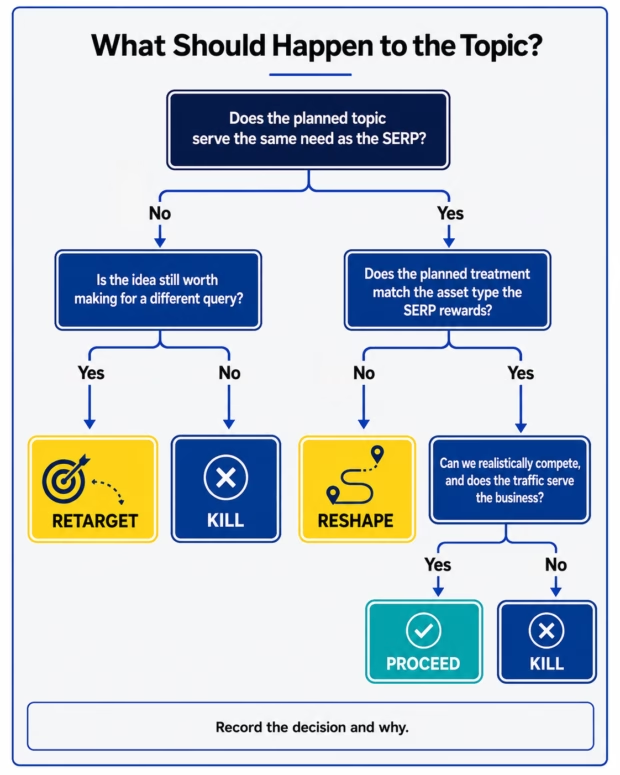
By this point you can resolve the topic. This is primarily an editorial-calendar decision, and it usually sits with whoever owns the calendar and can actually stop a piece. Pick one outcome and record why.
Proceed
Proceed when the angle matches the intent, the asset fits the SERP, the competition’s beatable, the traffic supports the goal, and you’ve got something useful to add. Carry the coverage, differentiation, and format notes into the brief.
Reshape
Reshape when the topic fits but the planned treatment doesn’t. A broad thought-leadership piece might become a how-to. A how-to might need a template, calculator, or comparison table to match the result pattern. Keep the keyword only if the reshaped asset still serves the need.
Retarget
Retarget when the article’s worth making but belongs to a different query. This is often right when your topic language overlaps the SERP while the reader’s job behind it doesn’t. Keep the idea, change the target, and rebuild around the new results page.
Kill
Kill it when the intent’s wrong, the required asset isn’t practical, the competition’s out of reach, the traffic carries little business value, or the piece would crowd something you already rank with. Stopping a piece here is a normal production decision.
A quick example: the AI content optimization article
This was the read that killed the article.
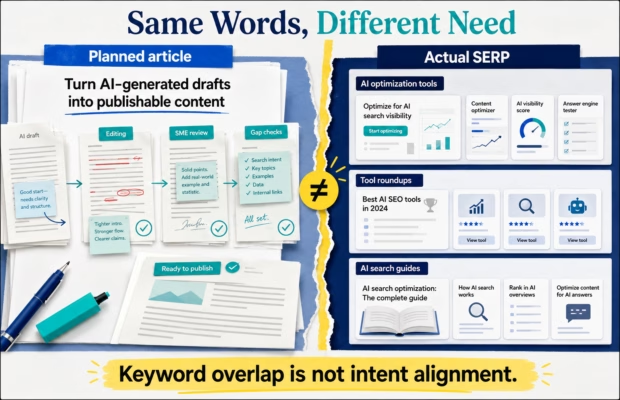
I had an AI content optimization piece approved on the calendar, brief mostly written, and the plan was to show teams how to turn AI-generated drafts into publishable content through editing, SME review, and gap checks.
The primary keyword showed around 1,000 monthly searches in the data I was working from. On paper, enough to carry the article and feed a related service.
Then I pulled the SERP. Page one was full of AI tools that optimize content. Tool roundups, broad guides, content about AI search. Nothing about cleaning up AI-generated drafts. The query wore the same words as my topic and served a different need.
Misaligned, full stop.
So I asked whether the piece should exist at all, instead of how to save it. The closest secondary was tiny and split between service and how-to intent. Commercial terms sat at rounding-error volume. Meanwhile, hundreds of thousands of searches in the wider space were hunting for free tools.
That traffic had the wrong intent, tough competition, and no path to the paid service, and the piece would have pulled against something already in our cluster.
So I killed it. Deleting the row was the win.
If you’re building briefs rather than owning the calendar, you may not have the authority to kill a piece, and that’s fine. Your job is to catch the red flag and raise it. A topic that cleared planning can still look wrong once you’re deep in the SERP, and flagging it early saves the writer from building on a weak foundation.
Build the baseline coverage spine
Now the stage shifts. The topic’s approved, and you’re building the brief. The ranking pages are your raw material, and this is where SERP research becomes an outline.
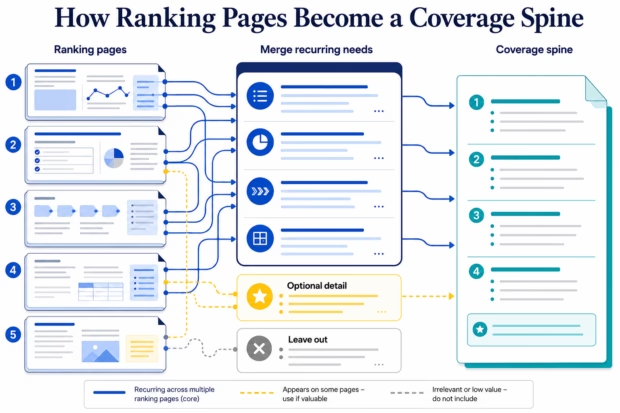
The baseline is the set of reader needs that recur across the relevant results. Pull them together and they form the spine the writer builds on.
Read the relevant pages as a set
Start with the pages that match the asset path you chose. Read them together and note the questions, concepts, distinctions, and steps that keep showing up. When something recurs across strong pages, readers probably expect it.
Separate the requirements from the extras
Work through a simple sequence:
- Review the relevant ranking pages.
- Pull out the recurring reader questions and required concepts.
- Merge duplicates and overlaps.
- Separate baseline requirements from optional detail.
- Test completeness against People Also Ask questions and supporting queries.
Say five ranking guides all cover subscription pricing. Four of the five cover the same core ground: pricing models, contract terms, usage limits, and overage fees. Two wander into procurement. One spends several paragraphs on company history.
The brief should require those four recurring topics. Procurement is optional, depending on the audience. Company history is one page’s detour.
The resulting spine might read:
- Explain the major pricing models.
- Show how contract length changes cost and flexibility.
- Clarify usage limits and overage charges.
- Help the reader compare total cost, not just the sticker price.
That’s a usable handoff, and it beats a copied list of competitor headings.
Test the spine with PAAs and supporting queries
Bring in People Also Ask questions and supporting searches after the first pass. They can surface a missing clarification, a different phrasing, or a practical sub-question the ranking pages handle lightly. Use them to test the spine, and leave out anything that pulls toward a neighboring intent.
Find a defensible reason for the article to exist
Baseline coverage makes the article complete. Differentiation is what makes a reader choose it over the results already ranking.
Useful differentiation tends to come from a few places, and they share one test: whether the addition helps the reader understand, decide, or act.
Missing or weak explanations.
The most useful gaps are practical. The ranking pages name a step but never show how to carry it out or what to do with the result. A few patterns to look for:
- They tell readers what steps to take without considering varying scenarios.
- They list factors to weigh without saying which one should win when those factors disagree.
- They walk through a clean, correct process but skip the messy step where the work usually breaks down in practice.
Filling gaps like these improves what the reader can actually go and do.
Stale coverage
Older results are an opening when something real has changed: a new product, a policy shift, an interface update, or a new regulation. When the existing answer still holds, a fresh publish date on its own won’t help you.
Experience and examples
First-hand experience can show where clean theory meets messy production, and a worked example can make a tradeoff concrete in a way general advice can’t. Even a well-thought-out contrarian take can earn attention too.
For all of them, the article should be able to explain why the addition helps the reader.
Know when to leave a gap alone
Not every omission is worth filling. Compare two:
- A useful gap: The ranking articles explain content-scoring tools but never say what to do when the tool’s score disagrees with what the SERP is actually rewarding. Closing that changes the reader’s decision.
- A gap to skip: None of them cover the history of content-scoring software. Adding it makes the article longer without making it more useful.
One question settles it. Will this help the target reader understand, decide, or act on the main query? If not, leave it out.
Use SEO tools and LLMs to speed up the analysis
A thorough SERP analysis takes real time, which is why it often gets rushed or skipped. Pairing a SERP analysis tool with an LLM removes most of the manual load at either stage, while the judgment stays with a person.
Start with an SEO tool that can pull the SERP for a keyword. A few worth knowing for this work:
- Semrush lists the ranking URLs alongside the SERP features present and per-page metrics like Authority Score, referring domains, and traffic estimates, so intent, difficulty, and the feature landscape come through in one view.
- Ahrefs is strongest on the link and content picture behind a result. Its keyword and SERP overviews show the top pages with ratings and traffic potential, and its content tools help you reverse-engineer why those pages rank.
- Moz keeps the read approachable, pairing each keyword’s likely SERP features and difficulty with Domain Authority and intent signals for a fast competitive picture.
From there, a capable LLM such as Claude or ChatGPT does the classifying and comparing, and you make the calls that need judgment. The three roles below split the work.
What the SEO tool retrieves
Start from the questions you need answered. For alignment, pull the ranking pages, titles, result types, and visible SERP features. For feasibility, add domain and page-level metrics. For the coverage spine, gather the relevant URLs, related queries, and supporting questions. Pulling every available report tends to create work without improving the decision.
What the LLM organizes
An LLM can classify page types, group title patterns, compare structures, pull out recurring concepts, and turn a pile of exports into a readable summary. That’s a real time saver, and it opens the work to strategists who know SEO but aren’t fluent in a given platform’s menus. The output still needs a human pass, since page fetches fail and pages get misclassified. The model organizes the evidence, and you confirm it.
What the strategist decides
The calls that need context stay with a person:
- Does the topic serve the same need as the SERP?
- Can the site realistically compete?
- Is the opportunity worth the slot?
- Which recurring topics are real requirements?
- Which gaps would genuinely help the reader?
- What’s the final call?
A practical Semrush-to-LLM workflow
Semrush now offers official MCP setup paths for bringing its API data into AI tools, including ChatGPT and Claude, and I’ve connected it to both. I ask for the current results, request a page-and-asset classification, compare the ranking pages, and pull supporting keywords in one thread, then check the output and make the call. In my experience, that removes most of the platform barrier for strategists who can describe the research they want but not the exact reports that produce it, and it’s quick enough to run during briefing.
Turn the analysis into the brief
The last step is moving what you learned into the brief so it survives to the writer. Some of it becomes standard brief fields. Most of the coverage work becomes the outline itself.
A few pieces become brief metadata:
- Search intent and audience, so the writer knows who they’re writing for and why.
- Content type and format, including any required support like a comparison table, template, or tool.
- Primary and secondary keywords, carried over from the planning decision.
The rest becomes the substance the writer builds from:
- The coverage spine turns into the outline, section by section.
- The differentiation angle tells the writer what to add that the ranking results miss.
- Feasibility notes and risks flag anything the writer or editor should watch.
Handled this way, most of the brief is just the analysis, organized. You’re not writing a separate document from scratch. Good content strategy depends on making these calls before drafting, while a change is still cheap.
Make SERP analysis part of the process
A SERP analysis works best when you run it twice: once to decide whether a topic deserves a place on the calendar, and again to turn the approved topic into a brief the writer can build on. Done at both stages, it keeps weak ideas off the calendar and gives strong ones a sharper starting point.
If you’d like help turning search data into clearer content decisions, Stellar’s SEO strategy services can support your planning and briefing.