

Healthcare content marketing fails in two common ways: it gets too bold with claims it can’t support, or it gets so cautious that it stops helping the reader.
That’s the tightrope. Your content has to be accurate without becoming cold, confident without overclaiming, compassionate without pretending certainty, and careful without turning every useful sentence into a disclaimer.
A thin article in another industry may only waste budget. A thin medical article can confuse the reader, overstate what the business can responsibly claim, or make a sensitive topic feel colder than it needs to feel.
The tips below walk through the decisions that matter most: what to publish, how to frame it, which claims need support, where experts belong, how AI fits, and what your review workflow needs to catch before the content goes live.
Tip 1: Define what healthcare content marketing has to accomplish
Before you assign topics, define the job your health content has to do. Healthcare content marketing uses educational content to answer health-related questions, earn reader trust, and support business goals such as visibility, inquiries, patient education, or service-line awareness.
That can include medical blog content, service pages, FAQs, patient education, hospital content marketing updates, and thought leadership.
Like financial and fintech, healthcare topics fall into YMYL territory when they affect finances, health, safety, or well-being, so trust signals matter more than they would in lower-stakes content.
In practical terms, your content has to do five things:
- Answer the reader’s real question. Not the keyword’s broadest possible meaning, but the question your audience actually brought to the page.
- Make your organization credible. The reader should understand why your brand, provider group, hospital, or medical business is a trustworthy source on the topic.
- Avoid unsupported claims. The article shouldn’t promise outcomes, imply certainty, or make promotional claims the evidence can’t support.
- Guide the reader toward an appropriate next step. That may be another educational resource, a service page, a form, a phone call, or a conversation with a clinician.
- Support the business goal without turning into a sales page. The content still has to serve the reader first.
That’s the difference between publishing health-adjacent content and building a real medical content marketing program. The goal isn’t to be louder. It’s to be more useful, more credible, and more careful where care actually matters.
Tip 2: Build the strategy around audience, risk, and business goals
A healthcare content marketing strategy should stop wrong-fit content before it reaches the draft stage. If your team assigns topics before it understands the audience, content risk, review needs, and business goal, the draft will make those decisions for you. It won’t always make good ones.
For example, a team may chase a symptom keyword because the search volume looks good. But if the business goal is service-line inquiries, the topic needs clinical review, and the reader is looking for reassurance rather than a sales path, the asset may need to be a patient education page or service-support page instead of a standard blog post.
How to create a healthcare content marketing strategy
Define the audience, intent, business goal, content type, review level, channel, publishing calendar, and KPIs before topics are assigned. That planning helps your team match content to reader need, business value, and health-specific review requirements.
A compact strategy should answer seven questions:
- Who’s the audience: patient, caregiver, provider, buyer, administrator, or agency client?
- What intent is the content serving: education, comparison, reassurance, service discovery, or decision support?
- What business goal does the asset support?
- Which channel or page type fits the job?
- What review workflow is needed before drafting and publishing?
- How does the content calendar balance priority, risk, and production capacity?
- Which KPIs will show whether the content is working?
This doesn’t need to become a massive planning ritual. It just needs to keep writers, SMEs, reviewers, and marketers solving the same problem. If the content needs clinical review, legal review, SME input, or tighter source rules, your team should know that before the draft exists.
Tip 3: Choose topics and formats around the reader’s real question
The best healthcare topic isn’t always the biggest keyword. It’s the topic that matches what the reader is trying to resolve and what your organization can credibly help with.
A data-seeking reader, a comparison-stage buyer, and a worried patient or caregiver may all search similar keywords.
They don’t need the same article.
Take a topic like “knee replacement recovery timeline.” That could be a patient education article, a surgeon-reviewed FAQ, a service-line support page, or a comparison-stage resource depending on what the reader needs. One version may need plain-language reassurance. Another may need practical milestones. Another may need to help the reader decide whether to contact a provider.
That raises the real planning question: if multiple audiences could search the same keyword, which one are you writing for?
You can’t be all things to all searchers. Choose the audience segment that matches your service offering, business goal, expertise, and intended next step. A hospital service line, a medical device company, a local clinic, and a B2B healthcare vendor may all have a legitimate reason to cover the same general topic. They shouldn’t all publish the same page.
We’ve found that factual, no-nonsense content works well when the reader wants knowledge, data, developments, or practical updates. That same tone can feel cold when the reader is trying to understand something affecting their own health or someone they love.
Use the format that fits the need:
- Blog posts: Explainers, timely education, and healthcare SEO content.
- Service pages: High-intent readers comparing care, coverage, or support.
- FAQs: Short, direct answers to recurring questions.
- Patient education: Plain-language guidance and next-step clarity.
- Case studies: Stories that can be told without creating privacy or overclaiming risk.
- Thought leadership: Expert perspectives, trends, and operational interpretation.
- Hospital updates: Location-specific programs, access changes, services, or community information.
Topic planning gets easier when you ask, “Which reader are we serving, what can we credibly help them do, and what business goal does that support?”
Tip 4: Write with useful confidence, not defensive hedging
Caution protects healthcare content. But caution can still fail the reader.
Some medical articles are so busy proving they’re careful that they forget to be useful. Every sentence gets hedged. Every claim gets buried under caveats. The piece may be safe, but the reader leaves with less clarity than they needed.
The goal isn’t to erase uncertainty or make health copy sound more certain than it should. The goal is to explain uncertainty like a person. Comfort doesn’t have to mean overpromising. Sometimes it means giving the reader a steadier, clearer way to understand what’s known, what isn’t, and what they should consider next.
Healthcare content is more useful when organization, word choice, and presentation are designed around what readers can understand and act on.
Readers experience your page as help or as yet another place where a simple answer became harder than it needed to be.
Over-hedging makes content less satisfying and less useful for readers who may be worried, vulnerable, or making difficult decisions. Responsible caution gives the reader context. Defensive hedging piles up caveats until the safest sentence is also the least helpful.
Before/after: cautious but cold vs. cautious and useful
| Version | Example |
| Cautious but cold | “Certain approaches may be associated with improved outcomes in some contexts, though individual results vary and no guarantee is implied.” |
| Cautious and useful | “Some people find this approach helpful, but results have varied. We recommend speaking with a clinician who can better explain how it might help you.” |
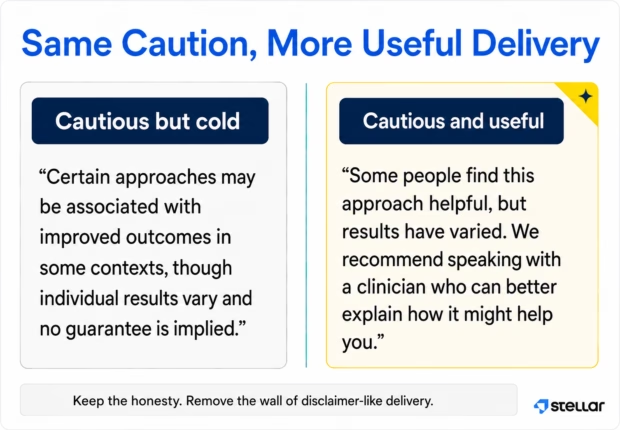
Our team often looks for that kind of shift: same caution, same honesty, less disclaimer-like delivery. Safer wording can still sound human. That matters when the person reading the page came looking for help, not a wall of liability padding.
Tip 5: Match every claim to evidence, risk, and review level
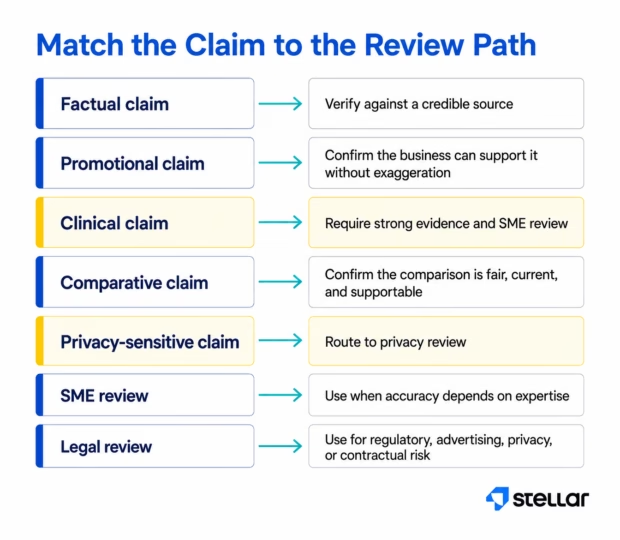
Healthcare content gets easier to manage when you stop treating every claim as the same kind of risk. A definition, a clinical claim, a service claim, a comparison, a testimonial, and an experience-based observation don’t need the same evidence or the same review path.
The liability concern is real. The practical question is usually simpler than it first sounds: can this claim be supported?
That question should shape the review process. A low-risk factual claim may need a credible source. A clinical claim may need stronger evidence and SME review. A promotional claim may need business verification. A comparative claim may need support, qualification, or a rewrite.
Health-related claims need evidence discipline: they should be truthful, not misleading, and supported strongly enough for the claim being made. Health-related marketing claims need careful review because regulators have repeatedly challenged false or misleading benefit and safety claims in health-related advertising.
A simple claim-strength rule
Use the claim type to decide what happens next:
| Claim type | Review action |
| Factual claim | Verify against a credible source. |
| Promotional claim | Confirm the business can support it without exaggeration. |
| Clinical claim | Require strong evidence and SME review. |
| Comparative claim | Confirm the comparison is fair, current, and supportable. |
| Privacy-sensitive claim | Route to privacy review. |
| SME review | Use when clinical nuance, patient safety, or accuracy depends on expertise. |
| Legal review | Use when the claim carries regulatory, advertising, privacy, or contractual risk. |
A claim like “same-day appointments available” needs business verification. A claim that a treatment improves recovery time needs stronger evidence and expert review. A claim that patients prefer one provider over another needs support or a softer, more precise framing.
Put the right claim through the right level of scrutiny before the article becomes expensive to untangle.
Tip 6: Bring SMEs in before the draft is already finished
SMEs are most useful before the article has already made its big decisions. If an expert only sees the finished draft, they can correct errors, but they have less room to shape the angle, outline, examples, and practical nuance.
This is where medical content teams often turn expert input into a checkbox: write the article, send it for review, add a “medically reviewed by” line, and move on.
That reviewer line can support trust, but it doesn’t automatically improve the article. A reader may notice the reviewer, check credentials, or give the page more initial trust because a credible person reviewed it. That’s valuable. It’s also not ranking magic, and it’s not a substitute for expert-informed content.
When the workflow allows it, use SME time while the outline can still change. Some workflows only allow post-draft review, and that’s workable when expectations are clear. But if you can get expert input earlier, use it to add direction before the writer locks in the article’s shape.
An SME may tell you that the reader’s first concern isn’t the one ranking articles emphasize. They may flag a common explanation as technically accurate but misleading. They may know which caveat belongs near the top because patients or buyers routinely misunderstand it.
A simple workflow works well:
- Build the outline around search intent, audience, and business goal.
- Ask the SME what experience-based insight, reader concern, decision point, or practical nuance the outline should add.
- Use that input to revise the outline before drafting.
- Draft from the revised outline.
- Send the finished draft for clinical, technical, or expert validation.
If expert time is limited, don’t spend all of it asking whether the finished article is “okay.” Use some of it where it can still change what the article becomes.
Tip 7: Treat patient stories as privacy-sensitive content
There’s a practical difference between general healthcare education and content built around a real patient’s story. A blog post explaining a condition, service, or prevention topic can still need careful sourcing, but patient stories, testimonials, lived experience, and identifiable health details create a different privacy conversation.
Patient stories and lived experience can add value, but they raise real consent and de-identification concerns when based on actual patients.
HIPAA concerns become more concrete when marketing uses or discloses protected health information, which is why patient stories, testimonials, consent, and de-identification deserve careful review.
The practical boundary is straightforward: if the content relies on a real person’s health situation, treatment experience, image, location, timing, or other identifiable detail, privacy review belongs at the planning stage.
Scrubbing a name from a story doesn’t automatically make it safe to use. Decide early whether the story can be used, what consent is needed, and how much detail can safely remain.
Storytelling can make health content more understandable and emotionally useful. The process around the story is what determines whether it supports trust or creates risk.
Tip 8: Use AI for efficiency, not certainty
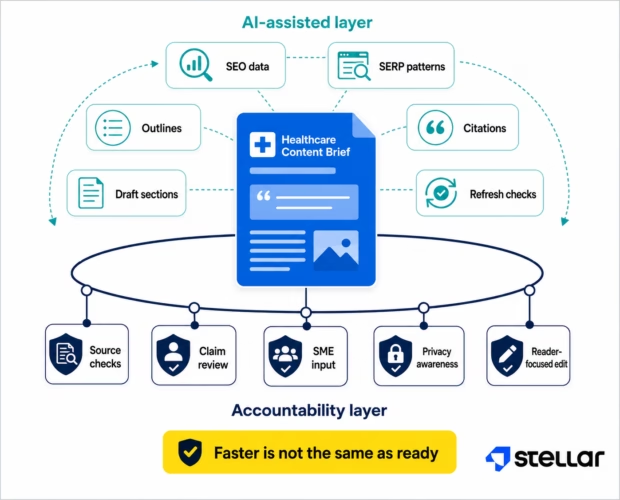
AI can speed up healthcare content production, but the best uses are more specific than “draft faster.”
Used well, AI can make planning, research, SEO, sourcing, and revision more accessible — especially for small healthcare businesses that don’t have a full content strategy team.
For example, AI can help your team:
- Turn SEO data into plain-English decisions. Pair an LLM with keyword or SEO tool exports to summarize search volume, keyword difficulty, intent, and topic opportunities in language a non-SEO stakeholder can actually use. Many SEO tools can now pair with your LLM via API or MCP so it can pull those exports itself.
- Analyze SERPs before outlining. AI can review top-ranking pages to identify common headings, missing angles, FAQ patterns, source expectations, and content-depth requirements before a writer starts.
- Scope the article. It can help decide whether a topic needs a short FAQ, a full educational article, a service-support page, or a more comprehensive guide.
- Build better outlines. AI can organize audience questions, search intent, business goals, and source material into a structure that gives the writer a stronger starting point.
- Format citations. Healthcare content often benefits from more formal citation handling than standard anchor-text linking. AI can help turn source lists into APA-style citations, check citation consistency, and reduce the manual cleanup that makes source-heavy content so slow.
- Draft first-pass copy. AI can help generate rough article sections, FAQ answers, meta descriptions, summaries, title options, and alternate explanations that a writer or editor can refine.
- Refresh existing content. It can compare an older article against newer source material, flag sections that may need updates, and suggest where the structure no longer matches current search intent.
Those uses can save real time. They can also make healthcare SEO decisions less mysterious for organizations that can’t afford a specialist for every content decision.
But AI should make the process faster, not less accountable. As with human-written healthcare content, the final version still needs source checks, claim review, SME input where appropriate, privacy awareness, and a reader-focused edit before publication.
And watch the language. The only thing that hedges more than a healthcare writer is AI writing about healthcare. Cautious wording may sound safe, but it doesn’t automatically make a draft accurate, useful, or ready to publish (see tip 4).
Tip 9: Structure content for search, AEO, and human answers
Answer engine optimization, or AEO, in healthcare content marketing is really a structure question: Can the page answer a clear question in a clear, sourceable way?
Some teams call this AEO, GEO, AI search optimization, or AI visibility. The label matters less than the structure. The page needs direct definitions, descriptive headings, recognizable entities, logical question flow, and evidence close to the claims that need it.
That doesn’t mean chasing a trick that guarantees AI Overviews, LLM answers, or featured snippets. It means making the answer easy to find and hard to misunderstand.
For example, a weak answer buries the point:
“Skin cancer screening recommendations can vary based on a person’s risk factors, personal history, family history, skin type, and clinician guidance. Adults with a history of skin cancer or other risk factors may need more frequent exams, while others may be advised to discuss screening frequency during a routine visit.”
That’s not wrong, but it’s hard to extract a useful answer from it.
A clearer version answers first, then qualifies:
“Adults should ask their clinician how often they need a skin cancer screening. People with a history of skin cancer, a family history of melanoma, many moles, or other risk factors may need skin checks more often than lower-risk adults.”
Then the page can explain what affects screening frequency, which warning signs deserve attention, and when to schedule an appointment sooner.
The same balance applies across medical content. Concise and direct doesn’t mean skeletal. Some businesses overcorrect for AI search and turn articles into outlines: headings, bullets, fragments, and very little narrative. That may look extractable, but it can be miserable for a human reader.
Use structure where it helps. Use narrative where the reader needs context. The useful standard is answerability, not gimmickry.
Tip 10: Measure performance without overclaiming what content can prove
Healthcare content reporting should be useful without pretending one article proves more than it can. A strong asset can support visibility, engagement, qualified actions, and brand credibility, but it can’t prove broad patient trust, health outcomes, or revenue impact by itself.
The safest reporting mistake is still a mistake: taking a real signal and turning it into a bigger conclusion than the data supports.
Track the categories that fit the content’s job:
| Measurement category | What to watch |
| Visibility | Rankings, impressions, traffic, and discovery across relevant queries. |
| Engagement | Scroll depth, time on page, return visits, and FAQ interaction. |
| Qualified actions | Form starts, appointment clicks, downloads, calls, or service-page visits. |
| Conversions | Lead quality, assisted conversions, and downstream inquiries where attribution is defensible. |
| Content quality | Review findings, source accuracy, claim issues, and readability. |
| Review efficiency | How often drafts move through SME, legal, or editorial review without major rework. |
The reporting should match the evidence. “This article increased clicks to a service page” is a defensible performance signal if the data supports it. “This article increased patient trust” is usually a much harder claim to prove from one asset.
A service page can support qualified inquiries, a patient education article can support visibility, and a thought leadership piece can support brand expertise.
Treat those as performance signals, not proof that content single-handedly changed a health or business outcome.
Tip 11: Don’t make the final reviewer repeat everyone’s work
The final reviewer shouldn’t have to redo every source check, claim review, SME pass, compliance concern, brand decision, and SEO edit from scratch. If that’s the workflow, final review isn’t a gate. It’s a bottleneck with a publish button.
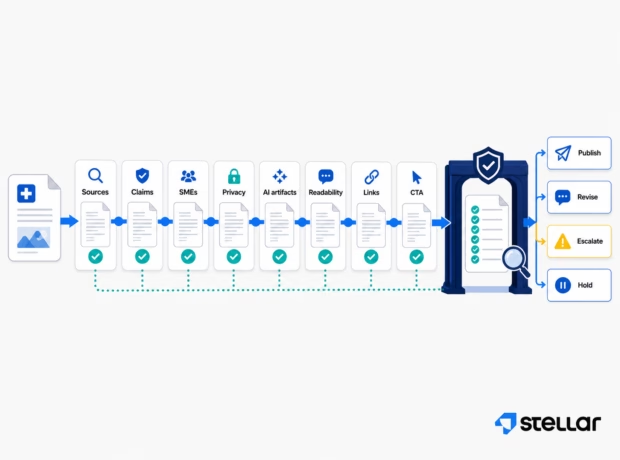
A better final review confirms that the right checks happened and spot-checks the work to keep the process honest. The reviewer should be able to see whether a claim was verified, whether an expert reviewed the right sections, whether privacy-sensitive material was escalated, and whether the CTA and internal links fit the page.
Before publishing, the final reviewer should confirm:
- Sources: Required sources are linked, current, and credible.
- Claims: Factual, promotional, clinical, comparative, and experience-based claims went through the right review path.
- SMEs: The right expert reviewed the right parts, and any unresolved notes were addressed.
- Privacy: Patient stories, testimonials, PHI-sensitive details, or identifiable information were reviewed before publication.
- AI artifacts: Hallucinations, stale citations, generic phrasing, and unnecessary hedging were checked.
- Readability: The intended reader can understand what to do or consider next.
- Internal links: Links support the reader’s next step, such as relevant managed content services.
- CTA: The next step fits the page and the brief.
The final decision should be clear: publish, revise, escalate, or hold. If the reviewer keeps finding the same kind of issue, the fix belongs upstream. Otherwise, final review quietly becomes the place where every weak handoff goes to hide.
For healthcare teams that need reliable planning, writing, and review support, see our healthcare and medical writing support.
FAQs about healthcare content marketing
What is healthcare content marketing?
Healthcare content marketing is the use of educational content to answer health-related questions, support informed decisions, and build trust with patients, caregivers, buyers, or professional audiences. It can include blogs, service pages, FAQs, patient education, hospital updates, and thought leadership.
How do you create a healthcare content marketing strategy?
Create a healthcare content marketing strategy by defining the audience, search intent, business goal, content type, review level, distribution channel, publishing calendar, and measurement plan. The strategy should connect reader need, content risk, and business value before topics are assigned.
What is AEO in healthcare content marketing?
AEO, or answer engine optimization, means structuring health-related content so answers are direct, clear, sourceable, and easy for search or AI systems to interpret. It supports answerability, but it doesn’t guarantee inclusion in AI Overviews, LLM responses, or featured snippets.
Why does project management matter in healthcare content marketing?
Project management matters because medical content often needs inputs from marketers, writers, SMEs, compliance reviewers, and editors. A clear workflow helps teams avoid late rewrites, missed reviews, unsupported claims, and publishing delays.
How does storytelling improve healthcare content marketing?
Storytelling can make health content more understandable, memorable, and emotionally useful. When stories are based on real patients or lived experience, they also require careful consent, privacy, and de-identification review before publication.