

Publishing more content isn’t what breaks quality. Adding writers, editors, briefs, and handoffs faster than you add control is.
I’ve watched capable programs drift for exactly this reason. Voice wanders. Requirements slip. Claims go out unverified. Not because anyone got careless, but because past a certain size, no single person can see every interpretation and every handoff across the full set. The small differences pile up.
Content quality assurance is the answer to that. It’s a process-focused review — the last checkpoint before content leaves production, and the one step built to catch what scale hides. Skip it, and someone downstream ends up playing the role by accident.
What Content Quality Assurance Is (and Why Volume Changes Everything)
Content quality assurance is a review step that checks finished content (blogs, landing pages, website copy, sales enablement copy, etc.) against defined standards before it moves to the next phase. On a high-volume program, its real job is bigger than catching defects in a single piece.
Production runs like a funnel. Many writers feed a smaller number of editors, who feed one or two QA reviewers. That shape is deliberate. It’s how you hold one consistent standard across a large body of work that dozens of different people had a hand in. Every writer and editor brings their own read on voice, positioning, and requirements. Narrowing everything to a final reviewer or two is what keeps those reads from turning into a set of articles that don’t sound like they came from the same brand.
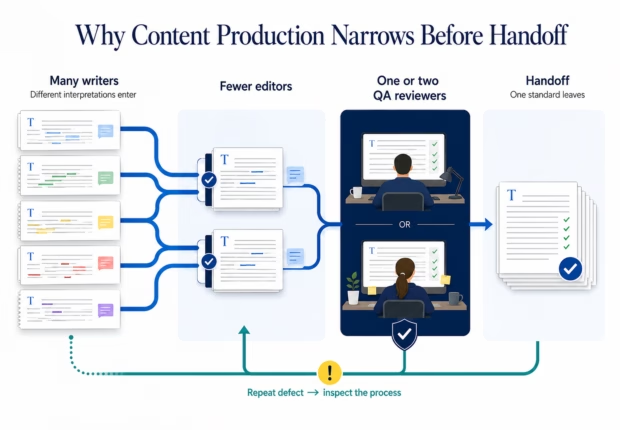
Catching granular issues is part of the work. QA verifies brief adherence, accuracy, compliance, and technical details, checks the known failure points for the project, and spot-checks writing quality and voice along the way. But the consistency the funnel produces is the benefit teams tend to underestimate. One unsupported sentence can be fixed. The same sourcing gap showing up across 50 pieces is a signal: a faulty requirement, a missed review step, or a bad project resource. The reviewer at the narrow end of the funnel is the only one positioned to see that pattern at all.
Content QA also protects the qualities search systems reward. Google’s guidance favors content that’s helpful, reliable, and built for people first, and of the signals its systems weigh, trust sits at the top. QA can’t promise rankings, but it can catch the broken link, the off-brief section, the unsupported claim, and the inconsistent product detail that erode trust.
Most teams already have an editor, which makes a separate QA pass sound redundant. The two roles do different jobs.
Content QA Isn’t Editing (and Why Conflating Them Fails at Scale)
An editor works inside the draft, and not only on the words. A good editor checks the piece against the brief, the requirements, the voice guide, and the structure, then fixes logic, clarity, wording, and flow. They spend real time with a draft, more than QA ever does.
That overlap is the part people miss. QA and editing check some of the same things. The difference is depth and position. The editor works one piece at a time and goes deep. QA works at the narrow end of the funnel, across the whole set, and goes for the known risks and the patterns a single editor can’t see from inside one draft.
Which leads to the rule that keeps the two roles honest: QA should never be the first person to check anything on a given piece. If QA is the first to notice a draft missed the brief, the editing step either didn’t happen or didn’t hold. A draft that still needs real rewriting isn’t ready for QA at all.
When a QA reviewer starts restructuring paragraphs, smoothing transitions, and repairing weak logic, the final gate turns into a second editing stage. Review slows. Work queues. So the program adds more QA reviewers to keep up, and now there are more individual reads at the exact point meant to standardize them.
Protect that line and you protect throughput. You also clarify what belongs on the checklist.
What a Content QA Review Actually Checks
A content QA checklist should reflect how a specific project fails, not every flaw writing could theoretically have.
Start with a consistent base, then add checks for the project’s recurring risks. If writers keep missing a product-naming rule, misreading a sourcing requirement, or drifting from the intended audience, that issue goes on the checklist by name.
Content Quality Assurance Checklist
Use this content review checklist as the final review sheet for each piece:
- Critical requirements and brief adherence: Does the content answer the assigned intent, cover every required point, follow the approved structure, and avoid prohibited claims or topics?
- Accuracy and compliance: Are factual claims supportable, qualifications preserved, required disclosures present, and high-risk statements routed to the right reviewer?
- Brand voice and tone: Do spot-checks across the opening, body, examples, and conclusion sound consistent with the brand?
- Writing quality: Any obvious logic gaps, awkward passages, repetition, unsupported leaps, or sections that should’ve been resolved in editing?
- Metadata and structured elements: Are the title tag, meta description, schema inputs, image text, and other required fields present and aligned?
- Links: Do internal and external links work, point where intended, use sensible anchor text, and support the surrounding claim?
- Accessibility and presentation: Are headings, lists, tables, image descriptions, and formatting usable and consistent?
- On-page SEO: Is the primary topic clear, are headings descriptive, and does the page answer search intent without keyword stuffing?
The base categories make reviews repeatable; the project-specific additions make them useful. When the same error keeps coming back, add it to the checklist, then go inspect the brief, style guide, editor guidance, or handoff that let it through.
A good checklist still fails, though, if it reaches the draft at the wrong moment.
Where QA Fits in Your Content Workflow
Timing decides whether QA works. Review too early and the reviewer checks content that’s still going to change. So station QA where it belongs: at the handoff between production and whatever comes next.
That next phase isn’t always publishing. It might be compliance, design, localization, or a client’s own team. Wherever production ends and another function begins, that seam is QA’s post. It’s the last point where the producing team still owns the work and can send it back cleanly.
The clean sequence inside production is:
Write → edit → QA → handoff
The writer executes the brief. The editor resolves structural and line-level issues and confirms the draft meets the requirements. QA, sitting at the seam, decides whether the piece passes to the next phase, returns for revision, or needs specialist review.
The handoffs expose whether the roles are working. If QA is still reorganizing sections or rewriting weak paragraphs, the editor handed off too early. If the next phase keeps sending work back, the QA seam isn’t holding.
Judge the workflow by what comes back and why:
- First-pass acceptance rate. A falling rate points to weak editing, confusing requirements, or a contributor mix that needs attention.
- Repeat defects. These tell you whether feedback is traveling back through the process or dying at the gate.
- Post-handoff corrections. What surfaces after the work leaves production reveals what the final review keeps missing.
A zero-return rate isn’t automatically good news. Maybe the upstream work is excellent. Or maybe QA is skimming and fixing issues without recording them. Either way, the signals tell you where to look, which is far more useful than declaring the content “looked fine.”
Before you decide how to run QA, though, decide whether it needs a real owner at all.
When Your Program Actually Needs Dedicated QA
Headcount isn’t the trigger people think it is. The trigger is streams.
Any time a piece can reach the next phase through more than one path, inconsistency becomes possible. Two writers is enough. They’ll read the brief differently, and without a common checkpoint, both reads ship. Add more writers and editors and the gap only widens. The question isn’t how many people you have. It’s whether more than one stream feeds the handoff with no single reviewer standardizing what passes through.
Three situations signal you need a dedicated owner:
- Multiple streams into one handoff. More than one writer or editor feeding the same output, with no one applying a consistent standard at the seam.
- Hidden review labor. Someone downstream is already doing QA without the title.
- High-cost defects. Content where a single miss carries legal, compliance, reputational, or customer risk.
Hidden review labor is the one that catches people off guard. We’ve had self-serve clients run higher-volume projects with genuinely capable writers and editors and still not get the work on track. Their expectation was reasonable: edited drafts should arrive consistent and close to publish-ready. What they didn’t see was that they’d become the QA layer themselves — reconciling voice, requirements, and quality across the set, piece by piece — without ever calling it that. Moving those projects into a managed workflow added a real QA gate, and deliveries got more consistent fast. In more than one case, that single change was the line between a project that was failing and one that worked.
High-cost defects can justify QA on their own. One wrong URL is all it takes. Mattel shipped Wicked dolls whose packaging sent buyers to an adult website instead of the movie site, which led to a recall and a class-action suit. Most content errors never carry stakes that high, and that’s the point: you don’t scale QA to volume, you scale it to risk. When a small defect can do real damage, the review function needs a clear owner early.
Someone always plays the QA role for at-scale production to work. You either assign it on purpose, or the client, customer, or publishing team ends up doing it after the handoff.
Should QA Be One Person or a Team?
When one reviewer can handle the volume, centralize. A single reviewer becomes one interpretation point for style, positioning, requirements, and acceptable risk. Writers and editors still make different calls upstream, but the final seam applies one standard across the set, and feedback coming from one source stays consistent.
Throughput sets the limit. The moment one reviewer has to rush, delay deliveries, or shorten the review to keep pace, you need more capacity. And here’s the catch: adding QA staff reintroduces the exact problem QA exists to solve. Two reviewers will split on small, defensible calls. One flags a sentence as off-brand while the other lets it ride. One demands a source while the other treats the claim as common knowledge. Neither has to be careless for the set to come out inconsistent.
At scale that variance is unavoidable, so the goal isn’t to dodge it. It’s to align the reviewers on purpose:
- QA reviews QA. Especially early in a project, have reviewers check each other’s work and note where they’d have called something differently.
- Log the disagreements. Track the calls that split the reviewers. Those are your alignment gaps.
- Meet to reconcile. Talk through the logged disagreements on a regular cadence and turn them into shared standards.
A shared checklist, shared pass-versus-return examples, calibration reviews, and clear escalation rules do the rest. Without them, you clear the queue and rebuild the inconsistency at the same time.
Staffing QA correctly still won’t save a workflow that hands QA the wrong authority. The operating rules do the rest.
The Operating Rules That Keep QA From Falling Apart
Whether QA is one person or several, four disciplines decide whether it improves production or turns into a patching station.
Return work for revision, don’t fix and ship
QA can clean up an isolated typo, a punctuation slip, or a small stylistic preference. What it should never do is fix and ship anything tied to a failed requirement, a compliance concern, a widespread quality issue, or a voice problem. That gets returned, with specific feedback.
The rule: fix an isolated mechanical issue; return anything that reflects a failed requirement, a failed editorial pass, or a pattern likely to repeat.
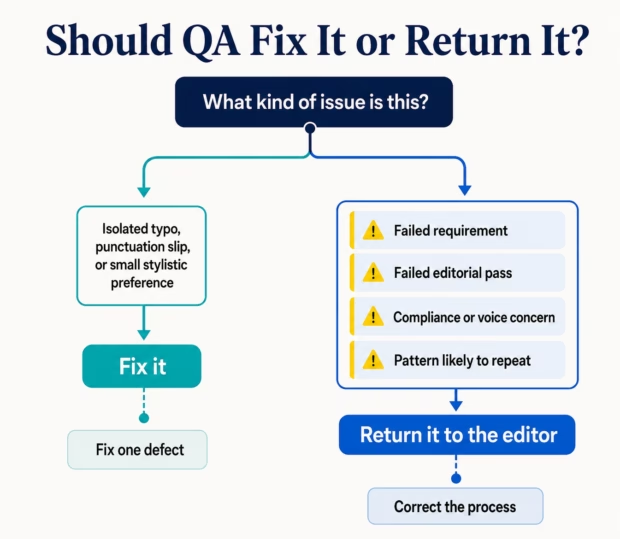
Say a draft consistently speaks to the wrong audience. QA could rewrite the offending paragraphs and push it through. The deadline survives, but the writer and editor never find out where the process failed. Return it with specific feedback instead, and the editor fixes it, the writer gets better direction, and the correction actually travels back through the workflow.
Fix-and-ship protects one deadline. It weakens every deadline after it.
Route feedback to the editor, not the writer
In a write → edit → QA workflow, QA feedback goes to the editor. Not the writer.
Sending it straight to the writer looks faster, and it is, for that one draft. But it skips the person whose job was to make the work QA-ready in the first place. A strong QA reviewer holds editors accountable for what they pass through, and that accountability is what turns an editor into a real gatekeeper. Editors who consistently see QA feedback start catching project-specific defects earlier and giving writers sharper direction. The only exception is a workflow with no editor in it. Then, of course, feedback goes to the writer.
Protect the QA buffer
The fastest way to break QA is to hand it whatever time is left before the deadline.
When writers and editors burn nearly the whole turnaround window, the reviewer has no real chance to return work and get a corrected version back. The only options left are missing the deadline or fixing the piece personally, and now you’re back in fix-and-ship mode. Set writer and editor deadlines backward from delivery, with protected time for QA and revision built in from the start, not tacked on if everything else happens to finish early. Without that buffer, the return-versus-fix rule only exists on paper.
Give QA access to fix problems at the source
The same mistake from several different writers usually isn’t a writer problem. It’s a project-resource problem.
A vague brief, a stale style guide, a contradictory example, a missing product rule: any of these can produce the same defect across an otherwise capable team. QA needs direct access to those materials and the authority to get them corrected. If three writers make the identical mistake and the reviewer can’t touch the brief that’s causing it, the system is forcing QA to treat the symptom while protecting the cause. Give the reviewer the access to fix it at the root.
Content QA in the AI Era
Adding AI doesn’t change who owns QA. It changes what the reviewer has to distrust, and it opens a second, separate question: whether AI can do part of the QA work itself. Those are two different problems. Take them one at a time.
Reviewing AI-assisted drafts
A weak human draft usually looks weak. An AI-assisted draft can be polished, well-organized, and wrong in ways that survive a casual read. That fluency breeds false confidence, so the reviewer has to verify exactly what the draft makes easy to assume.
I’ve learned to get more suspicious when the writing reads clean, not less. In the largest study of its kind, nearly half of AI assistants’ news answers contained at least one significant error. Fluent isn’t the same as correct.
For AI-assisted content, QA should pay special attention to:
- Fluent-but-wrong claims: statements that sound settled but aren’t supported by the source.
- Weak or fabricated sourcing: citations that don’t back the sentence, lead nowhere, or were inferred rather than verified.
- Sameness and voice drift: repeated sentence patterns, generic phrasing, brand language flattened into model defaults.
- Surface-correct but off-brief output: clean prose that answers a nearby question instead of the assigned one.
Google has said plainly that using AI or automation isn’t a violation on its own. Using it to churn out content that games rankings is.
Using AI as a QA tool
AI can do real QA work, but only from the right seat. The rule is simple: AI never sits at a handoff. A handoff is where one function passes ownership to another, and that decision needs a human who can be held to it.
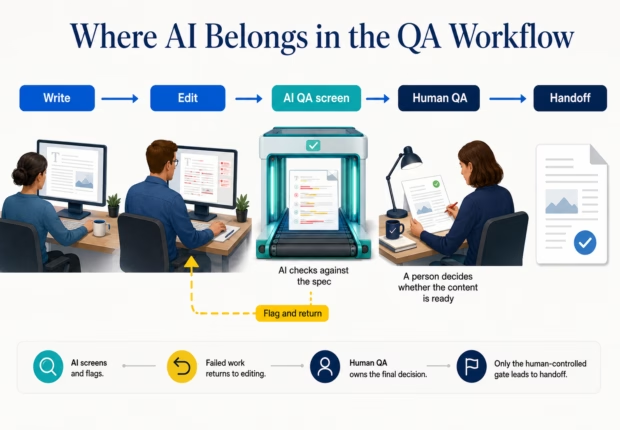
Where AI earns its place is one step earlier, between the editor and human QA. Point it at a near-final draft and it can compare the piece against the brief, flag inconsistencies, and surface likely sourcing problems, then kick the draft back to the editor to fix. Think of it as a QA junior: it screens, it flags, it returns work for correction. Only once a draft clears that automated pass does it reach the human QA sitting at the handoff.
That keeps the speed where AI is strong (tireless, consistent pattern-checking against a spec) and keeps the judgment where it belongs. AI can tell you a citation doesn’t match its sentence. It can’t decide whether the brand should stand behind the page. Put AI at the handoff and you’ve automated the one call that most needs a person. Put it one step back and it makes your human QA faster without ever making the final decision.
Frequently Asked Questions
Is content quality assurance the same as editing?
No. Both check the draft against the brief, requirements, and voice, so there’s real overlap. The difference is depth and position. An editor works one piece at a time and goes deep on structure, logic, and wording. QA sits at the narrow end of the production funnel, reviews across the whole set for known risks and patterns, and should never be the first to catch a problem the editor was responsible for.
What’s the difference between content QA and quality control?
Teams use the terms interchangeably. A useful distinction: quality control catches defects in an individual piece, while quality assurance also improves the process producing those defects. A good QA reviewer does both, returning a flawed draft and updating the checklist or project resource that let the problem through.
Can AI handle content quality assurance?
AI can assist, not own it. It works well one step before the human reviewer, between the editor and QA, where it screens a draft, flags issues, and kicks the work back for correction. It should never sit at the handoff to the next phase, because that’s where a person has to decide whether the content is ready to represent the brand.
When do you need a dedicated QA role?
As soon as content can reach the next phase through more than one stream. Even two writers can produce an inconsistent set without a common checkpoint. High-risk content, or corrections that keep surfacing after handoff, can justify a dedicated owner sooner.