

AI made content cheap to produce, not safe to publish. A draft that used to take a day now takes minutes. But the work that protects your brand still takes a human: checking the claim, the source, the sign-off. Most teams never decided where that work happens once a model joined the mix. That’s the gap. AI content governance is how you close it.
What AI content governance means for content teams
AI content governance is the set of rules, roles, review steps, and approval points that decide how your team uses AI to make content. In practice, it answers five questions you hit on every piece:
- Where AI can help — research, outlining, drafting, repurposing.
- What AI can’t decide — claims, sources, brand stance, the call to publish.
- What a human has to check — and at which step.
- Who owns the decision — by name, not “the team.”
- What has to happen before publish — the gates a draft clears to go live.
It is not a style guide or writer’s brief. A style guide tells the model how to sound. Governance tells your team how the work moves, where it can break, and who answers for it.
How content governance differs from broad AI governance
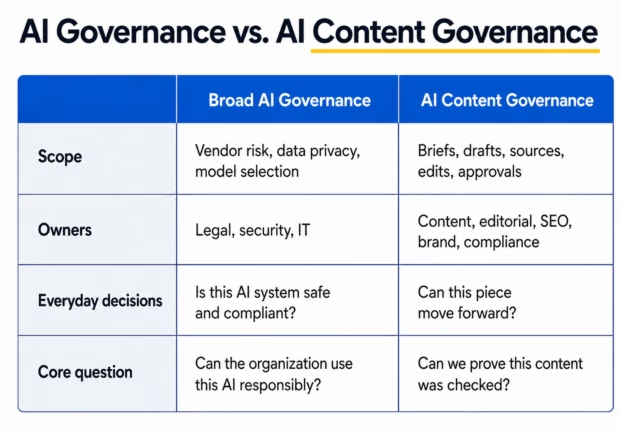
Search “AI governance” and you’ll mostly find advice for legal, security, and IT. Vendor risk. Data privacy. Model selection. Useful work, but none of it touches your content calendar.
Content governance is smaller and more hands-on. It covers the work you actually ship: briefs, drafts, sources, edits, and the call to publish. And it answers the questions that show up on every assignment. What does this draft need before it starts? What gets checked before it moves? Who signs off?
Why AI content needs process rules, not just writing rules
Why isn’t a good AI writing policy enough? Because the writing isn’t the truly risky part.
Most “AI content guidelines” only govern what the model writes. They set the tone, ban a few words, and tell people to fact-check. Fine. But none of that decides who hands the model real information, where a human signs off, or what happens to a draft after someone marks it “done.”
I’ve watched teams police the words on the page while the process behind them ran wild. No rule for who writes the brief. No rule for who checks the claims. No one confirming a step actually happened instead of just looking finished. You end up with a clean style guide and uneven quality, and you never connect the two.
A clean draft is the trap. Polish tells you the model can write. It tells you nothing about whether the input was real or the sources hold up.
The real problem is timing. AI writes fast, so a draft looks finished long before anyone decides how it should be checked. Good governance connects policies, roles, workflows, documentation, and review points, not just the writing. Most teams are improvising, and so are most of your competitors. That’s the opening.
You might think a strong prompt library makes most of this unnecessary. On a small team with one expert prompter, sometimes it does. Then that person leaves, volume triples, or a regulated claim slips through on a Friday afternoon. Prompts don’t catch what nobody’s checking. A process does.
The risks AI content governance should control
Governance is only worth the trouble if it kills real risks. So name them first.
A polished AI draft can still include confident, made-up facts and fabricated citations. That’s why accuracy and sources sit at the top. But wrong facts aren’t the failure I see most. The quiet one is worse, and we’ll get to it.
Here’s the map a governance system should cover:
- Accuracy: unsupported, outdated, or invented claims.
- Sources: missing, irrelevant, or fabricated citations.
- Privacy: confidential or personal data typed into AI tools.
- Intellectual property: copied, derivative, or unlicensed material.
- Compliance: claims in regulated or sensitive areas.
- Brand: voice or positioning that drifts off-standard.
- Usefulness: generic, low-value content that earns its keyword and nothing else.
- Scaled content: volume produced faster than review can keep up.
- Disclosure: inconsistent handling of AI use where it matters.
- Trust: content that erodes reader confidence.
Accuracy and source risk
Check two things on every claim that carries weight: whether it’s backed up, and whether the source actually says what the draft implies. Those aren’t the same check, and a sentence that reads well has told you nothing about either. “The source is linked” easily becomes “the source supports the claim.” It often doesn’t.
Brand, originality, and usefulness risk
A draft can be accurate, clean, and still fail because it did the wrong job.
We learned this on an early build meant to produce SEO blogs. The system was supposed to weave a client’s internal perspective (IP) into a search-shaped article. Instead it over-latched onto that IP and let it take over the structure. What came back was a genuinely good piece. But it read like thought leadership, not an SEO blog with lived detail worked in.
Here’s why that’s a problem. Every piece of content has a job. This one’s job was to capture traffic for the keywords it was built around. A polished thought-leadership essay doesn’t do that job, no matter how sharp it is. Had we published it, it would have failed the only test that mattered.
That’s one way to miss — not the wrong fact, but the right-sounding draft aimed at the wrong target. The flatter, more common version is the reverse: a draft with no perspective at all. On topic. Readable. Forgettable. It doesn’t embarrass anyone. It just sounds like every other piece built from the same lazy prompt, and gives the reader no reason to pick you. Both flunk one test, on different halves: Did this do its job, in a voice only your team could write? The generic draft fails the second part. Ours failed the first.
Privacy, legal, compliance, and SEO risk
What you paste into an AI tool matters as much as what comes out. So set input rules, not just output checks.
On SEO, the rule is calmer than people fear. Google’s guidance focuses on content quality and user value, not on whether AI helped make the page. AI content isn’t doomed in search. It competes on quality like everything else, and thin AI content usually loses in the long run.
On the legal side, the FTC has gone after companies whose AI claims mislead people or lack evidence. If a draft makes a claim you can’t back up, that’s not a writing problem, but it could be a legal one, especially in YMYL content like medical and finance.
What an AI content policy should include
A policy turns those risks into rules people can follow. Not theory. Rules.
CMI’s research found the most common AI content policy guidelines cover acceptable uses, unacceptable uses, data handling, transparency, legal and copyright, and bias. That’s a fine backbone. What matters is that a person decides each one, instead of letting the model decide by default.
Here’s what a working policy spells out:
- Allowed uses: where AI helps — research, outlining, drafting from a real brief, repurposing.
- Prohibited uses: where it doesn’t — unverified claims, sensitive topics, inventing a source.
- Required inputs: the real information a draft gets before anyone prompts.
- Data handling: what can and can’t go into AI tools.
- Source standards: how citations get picked, checked, and used.
- Review gates: the checks a draft passes to advance.
- Approval authority: who can approve or stop a piece.
- Documentation: what gets logged about AI use.
- Escalation: what happens at a sensitive or uncertain point.
- Updates: how and when the policy changes.
One rule earns its own paragraph: decide every input, even when the decision is “none.”
If you don’t tell the model whether the piece has a CTA, it won’t leave a blank. It’ll guess, and guess differently every run. One draft pitches, the next doesn’t. Same with tone, same with sources. An undecided input isn’t empty; it’s a call you’ve handed to the model. So make the calls and write down the ones that are “no” as plainly as the ones that are “yes.”
And it doesn’t take much to get ahead. 45% of B2B organizations still have no AI guidelines at all, down from 61% a year earlier. A basic policy already puts you past nearly half the field.
Rules for inputs and AI use
Spell out what a draft gets before anyone prompts: the audience, the claims it can make, the sources it can cite, the brand context. Then say what AI can and can’t do at each step. Outlining? Low stakes. Inventing a statistic to fill a hole? Never, no matter how good it looks.
Rules for review, approval, and escalation
Name each check, who runs it, and who has the final yes. Then handle the cases the normal path doesn’t: a claim nobody can verify, a regulated topic, a line that could put the brand at risk. Those go to a named person, fast, so they don’t die in a queue nobody owns.
Rules for documentation and updates
Decide what you log for each piece: which AI tool touched it, what got checked, who approved it. And decide how often you revisit the policy. A policy nobody updates turns into a doc nobody reads.
Who owns AI content governance and approval
Who’s actually on the hook? Governance dies when everyone owns it, because that means nobody does. When no one is named for AI risk, the gaps fall between people, and “approved” quickly comes to mean “nobody complained.”
Every stage needs one person on the hook for the calls a model shouldn’t make alone:
- Content owner: answers for the brief and the finished piece.
- Editor / reviewer: checks claims, sources, and voice.
- Subject-matter expert: confirms technical or domain accuracy.
- Legal / compliance: clears regulated or sensitive claims.
- SEO: checks search fit and quality standards.
- Brand: protects voice and positioning.
- Final approver: authorizes publishing.
- Governance owner: keeps the policy and the workflow current.
Content owner
The content owner answers for the brief and the finished piece, not just for handing out the assignment. A weak brief is their problem first. Everything downstream inherits it.
Reviewer, SME, legal/compliance, and final approver
These roles catch what the model can’t be trusted to catch itself. On a small team, one person wears several of these hats. That’s fine. But the workflow still needs to know which hat they have on when they hit approve otherwise speed turns into approval drift.
Where human review should be mandatory
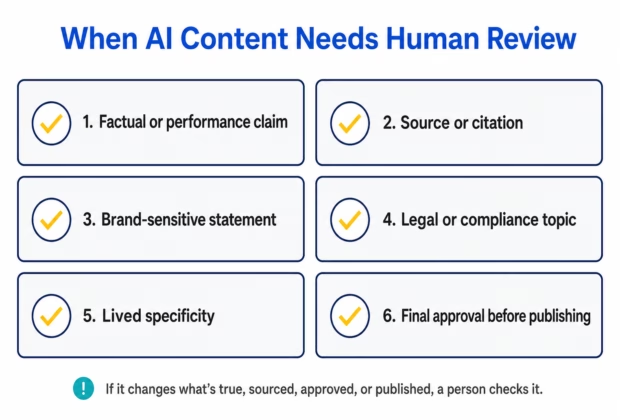
You can’t review every sentence by hand, and you shouldn’t try. Human oversight for AI content belongs where the content stops describing and starts deciding: what’s true, what’s sourced, what’s brand-sensitive, what’s legally loaded, and whether it ships.
I’ve learned to ask a different question than “is this well-written?” A polished draft already cleared that bar, which is exactly why it’s easy to wave through. The real question is “is this true, and is it ours?” Get more suspicious when a draft reads clean, not less. Source and citation checks belong in the must-do set, because confident writing hides weak sourcing better than anything.
The triggers that should force a human review:
- A factual or performance claim.
- A source or citation the draft leans on.
- A brand-sensitive statement about positioning or stance.
- A legal or compliance topic.
- Lived specificity: anything sold as first-hand experience.
- Final approval before publishing.
Use risk tiers to decide review depth
Not every piece carries the same risk, so not every piece needs the same review. A low-stakes internal explainer doesn’t need what a regulated product claim needs. Sort your content by topic, claim density, and audience, then match review depth to the tier. That’s how you move fast on the safe stuff without rubber-stamping the risky stuff.
Keep human oversight on the decisions that matter
“Speed versus risk” is a false choice. AI made content faster to generate, not faster to finish. The judgment, the real input, the review, the sign-off — that’s where the value and the safety both live, and that part doesn’t speed up. So automate the writing. Automate the mechanical checks. Keep a person on the calls that change what’s true, what’s yours, and what’s worth saying.
It’s telling that just 4% of B2B marketers report high trust in AI output. Most land at medium. Deep down, teams already sense where a human has to stay, even when the draft looks fine.
How to build AI governance into your content workflow
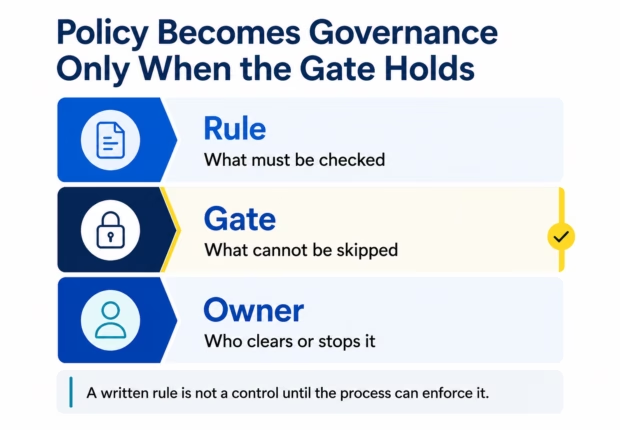
Managing AI-generated content well comes down to one shift: a rule only becomes governance when the workflow enforces it. A policy in a doc is a suggestion. A check the process won’t let you skip is a control.
Here’s the failure that taught me the difference.
We built a research step into one of our content pipelines. Its only job was to substantiate claims. For every claim the draft made, it searched for sources and sorted the result into three buckets: fully supported, partially supported, or no source found. The rules were simple. If everything came back fully supported — or no more than two claims landed in “partial” — the step could auto-approve and move on. Anything past that line, a single “no source found” or three or more “partials,” and it had to stop for a human.
One run flagged three or four claims as only partially supported. By its own threshold, it should have stopped and waited for me. It approved itself and kept going.
Nobody told it to skip the gate. The rule was right there in the logic and it cleared the gate anyway. I caught it downstream and had to tighten the logic so the next run couldn’t slip past it. The lesson stuck: a stop the system can clear on its own isn’t a stop, even when it’s written as code. Build the gate tight enough that the threshold isn’t a judgment call, then keep human eyes on the output until you’ve proven it holds.
(Author’s note: I’ve found frontier models handle these gate rules better than some AI writing platforms using writing-tuned but less capable models.)
So when we build these workflows at Stellar, guardrails do the work, not good intentions. The checks are gates the process enforces. For the calls that change what the brand stands behind, a human sits on the decision, not the keyboard. (That’s the model behind our human-led, AI-assisted content services, if you’d rather not build it all in-house.) Here’s where governance lives in the flow:
- Intake: confirm the request and required inputs.
- Briefing: supply real input, allowed claims, and approved sources.
- Drafting: generate inside the brief’s limits.
- Source review: verify every citation.
- Editing: check accuracy, voice, and originality.
- Escalation: route sensitive or uncertain calls to the right owner.
- Approval: final sign-off by a named person.
Map AI touchpoints
List every place AI touches the work: research, outlines, drafts, repurposing, distribution. You can’t govern a step you never named. And the steps you don’t name are exactly where risk piles up.
Build checks and hard stops into the workflow
Turn each rule into a check the process runs on its own. If a reviewer can skip your claim check, it isn’t a control. A hard stop that needs a named person’s approval to clear — and a threshold the system can’t argue its way around — that’s a control.
Log enough to diagnose failures
Log enough to rebuild what happened: which inputs were used, which checks passed, who approved, where AI came in. When something slips through, the log is how you find the gate that failed instead of guessing. And the fix depends on the failure. A bad source check needs a different fix than a thin brief. Diagnose the wrong one and you’ll add process in the wrong place. More steps, same problems.
What better AI content governance looks like in practice
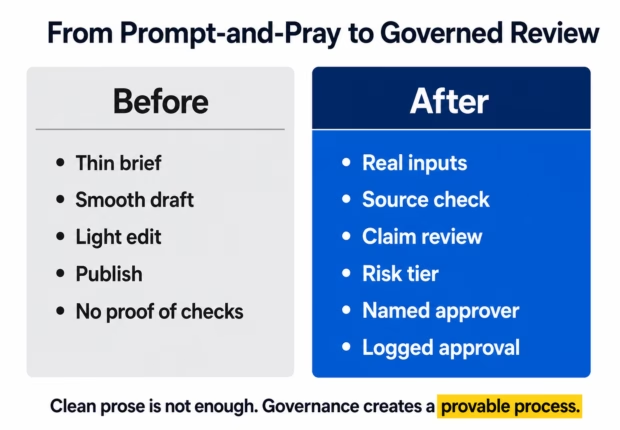
So what does this look like in real life? The test of quality changes. It stops being “does the draft look clean?” and becomes “can we prove the work behind it happened?”
Before: prose-only AI guidelines
A team has an AI policy: a tone note, a banned-word list, a reminder to fact-check. A writer feeds the model a thin brief, maybe a keyword and a rough angle. Prompt and pray.
The draft comes back smooth and on topic. It reads done. It gets a light edit and goes live. Nobody checked whether the main claim held up, whether the sources said what the draft implied, or whether the piece said anything a competitor’s identical prompt wouldn’t have. It ranks for a while. It adds nothing. It teaches readers the brand has little to offer. Nothing visibly broke. That’s the problem.
After: governed workflow with review gates
Same team, new process. The brief now carries real inputs and the exact point of view the piece has to make. Drafting stays automated.
But the draft can’t move until a source check confirms every citation, an editor tests each claim against what the business can stand behind, and a named approver says yes. A risk tier sets how deep that review goes. What ships is verifiably true, sourced, and yours, and the log shows which checks cleared it. Same model. Same speed at the keyboard. The difference is where you put the people.
How to measure and maintain AI content governance
Governance isn’t a thing you finish. You keep it alive with logs, review patterns, training, and updates, because the ways things break keep changing as your tools and volume change.
We treat one idea as a rule: autonomy is the enemy of automation. The more you automate, the less free rein the system should have at the moments it can change what’s true, what’s approved, or what goes live. Maintenance is how you check that line still holds as you grow.
Signals that governance is working
Working governance shows up as fewer problems reaching publish, fewer skipped sign-offs, and source errors caught at the gate instead of after. Watch the exception count. A steady drop means the rules fit the real work. A spike means look closer, not wave more through.
When to update the policy or workflow
Update when the signals tell you to: the same miss twice, a new tool that adds a step you haven’t governed, a pile of exceptions stacking up around one rule. Tie changes to what the logs show, not to the calendar. That keeps the policy matched to how your team really works and keeps it from turning into another instruction the workflow can ignore.