


The easy question is whether to outsource blog writing. The harder one is what to outsource. Most marketing teams reach for outside help when capacity gets tight, but capacity is rarely the only thing in play. The decision sits on top of strategy, briefing, voice, and review — and the cleaner you are about which of those stay in-house, the better any outsourcing arrangement works.
Key takeaways
- Outsourcing is a workflow integration, not a handoff. The cleaner you define what stays in-house, the better the partnership works.
- The right model depends on how much of your strategy, briefing, and quality control you can keep on your side.
- Quality in 2026 isn’t polish. Polished prose is table stakes. Quality is message value, brand perspective, and search fit without reader degradation.
- AI is a fourth production option, not a shortcut around strategy. It changes the model. It doesn’t change the need for inputs, review, and human accountability.
What it means to outsource blog writing in 2026
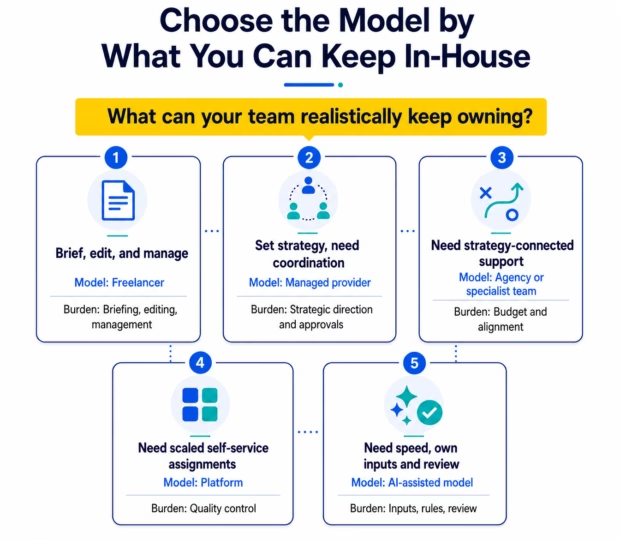
Outsourcing blog content writing now means more than handing a topic to a freelance writer and waiting for a draft. You may be using a freelancer, agency, managed provider, content platform, AI-assisted workflow, or some mix of those. The real decision is which parts of strategy, production, editing, and workflow ownership should sit outside your team.
Freelance writers
A freelance writer is an individual contractor you brief, manage, and edit directly. Strong fit when your internal strategy and editorial oversight are already in place. You get flexibility; you keep the management work.
Agencies and managed providers
Agencies typically bundle strategy, writing, and campaign support. Managed providers focus on production at scale: writer matching, editing, coordination, and calendar management against a recurring brief.
This works when you need consistent output across multiple writers and topics, and when you’d rather pay for the operational layer than build it.
Content platforms
A platform gives you marketplace-style access to a writer pool with built-in assignment tools. The model fits when you need volume and self-service is more useful than a managed relationship.
AI-assisted workflows
AI workflows combine prompt-driven drafting with human review. They can be internal builds or provider-built systems your team operates. The tradeoff is control: speed only helps when the inputs, rules, and review process are strong enough to make the output worth publishing.
When outsourcing blog writing makes sense
Outsource when your publishing goals exceed your internal writing capacity, specialization, or workflow bandwidth. Volume is the obvious trigger. Variety is the better diagnostic. One writer may handle thought leadership well and produce middling work on a technical explainer the next day, not because they’re weak, but because the two assignments are different jobs.
The moment to outsource is when the constraint moves from “we need more words” to “we need reliable production across topics, formats, and expertise levels our team can’t cover without quality dropping.”
Capacity signals
Capacity problems show up when the work can happen but doesn’t move. Drafts sit too long. Publishing goals keep slipping. Your content calendar runs on unsustainable extra effort. “We’ll squeeze it in” becomes the plan, and it works until it meets a real deadline.
Specialization signals
If your internal writer is strong but stretched across too many kinds of work, the issue isn’t talent. It’s fit and bandwidth. Outsourcing fits when you need writers who can move between audiences and formats without losing accuracy.
Complex-topic signals
Finding reliable writers is hard even for general topics. It gets harder when the work involves fintech, finance, healthcare, insurance, legal, cybersecurity, or other specialized subjects. Outsourcing makes sense when you need writers who can handle nuance, use credible sources, and avoid unsupported claims without turning every draft into an internal rescue project.
Workflow and strategy signals
Outsourcing also fits when your team needs help turning briefs into assignments, matching the right writer to the topic, and keeping the calendar moving. If the strategy itself is the gap, you need a partner that can support planning and editorial direction, not just drafting.
How to choose the right outsourcing model
Choose by fit, not price alone. The cheapest model gets expensive fast if it needs more strategy, editing, and coordination than your team can give it.
Use this provider-evaluation checklist as you compare options:
- Strategy support: Will they push back on a weak brief, or just write to it?
- Briefing process: Who’s responsible for closing the gaps before a writer starts?
- Workflow integration: Can they work inside your tools and rhythms, or only their own?
- Writer matching: Is there someone on their side pairing topic to writer, or is it whoever’s available?
- AI process maturity: Do they have a defensible system, or just a tool subscription?
- Quality standards: What gets caught before the draft reaches you?
Best fits for outsourcing blog writing
Use the checklist above to narrow the model, then compare the operating tradeoffs below.
| Model | Best fit | Main internal burden | What to evaluate |
| Freelancer | Extra drafting capacity | Briefing, editing, management | Portfolio fit, availability, communication |
| Managed provider | Recurring production and coordination | Strategic direction and approvals | Workflow fit, writer matching, quality standards |
| Agency or specialist team | Strategy-connected content | Budget and alignment | Subject expertise, service scope, collaboration model |
| Platform | Scaled assignment management | Quality control | Writer access, process visibility, review support |
| AI-assisted model | Speed and repeatable workflows | Inputs, rules, review | Prompt quality, human oversight, brand standards |
Freelance writer
A freelancer is the right choice when your internal strategy and editorial oversight are already strong. You manage the brief, the relationship, the feedback, and the final quality. The team carries the project management load.
Managed content provider
Managed providers fit when you need recurring production, editorial coordination, and writer matching. A model like blog writing services or managed content services fits when the need includes process support, not only draft creation.
Workflow fit is where this either works or quietly doesn’t. A rigid provider creates friction whenever your approvals, tools, or communication habits don’t match their template. The question to ask is whether they can work inside the reality of how your team gets content published, not the version of your workflow that exists in a slide deck.
Agency or specialist team
Agencies and specialist teams fit when blog writing is tied to campaign support, SEO strategy, product messaging, or industry-specific content. That can be worth the premium when those layers solve a real problem. It’s harder to justify when you only need strong drafts.
Platform or AI-assisted model
A platform or AI-assisted model fits when you need speed, structured production, or repeatable content types. It’s weaker when the work depends on brand judgment or subject-matter validation. The more the article relies on nuance, the more review matters, and the less the speed advantage means on its own.
What it actually costs
Keeping blog writing fully in-house carries a real salary baseline. The median U.S. wage for writers and authors was $72,270 in May 2024. That’s context, not proof that outsourcing is always cheaper.
The honest range on outsourced blog writing is wide. A blog post can cost practically nothing for unedited single-prompt AI output or thousands for long-form thought leadership that’s fully human and includes SME interviews and expert review. But with most outsourced options, expect to pay $100 to $300 for a fully human-written and edited 1,000-word article.
Yes, you can find writers willing to work for less (even less than five cents a word), but in most cases, you get what you pay for.
AI complicates the cost picture. Sophisticated AI production reduces actual drafting costs, but some of those saved costs shift to new roles or increased effort in pre- and post-production. Platform costs are real too: Enterprise solutions for some powerful AI tools can run into the tens or even hundreds of thousands of dollars a year just for the right to use the tool, before any content is produced.
When comparing providers and freelancers, look at the big picture. A per-word or per-article rate may look inexpensive until you realize it covers drafting only, while a higher rate may include freelancer sourcing, deadline enforcement, formatted deliveries, editing and QA, and unlimited revisions. Lower cost on the line item is not lower cost overall if your team has to rebuild the brief and rewrite the draft.
What changes about briefing when the writer is outside your team
We see a lot of teams under-brief outsourced writers, sometimes giving only a title and a primary keyword. That’s not enough direction for content expected to compete on the SERP or represent the brand well. An internal writer absorbs strategy through proximity: meetings, slack threads, hallway context. An external writer has none of that. The brief is the only context they get.
The handoff has to do more work. A brief for an outsourced writer should make explicit what an internal writer would have picked up by being around.
What an outsourced writer needs that an internal one doesn’t
The internal writer knows the goal, the audience, the brand position, and the politics. The external writer is starting from your brief and nothing else. That changes what the brief has to carry.
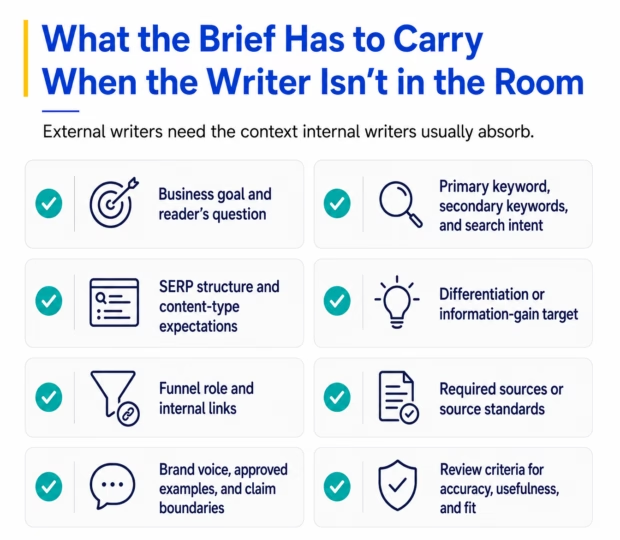
A practical handoff for outsourced work includes:
- The business goal and the reader’s question, not just the topic.
- Primary keyword, secondary keywords, and search intent.
- SERP structure and content-type expectations.
- Differentiation or information-gain target: what this piece should add beyond what’s already ranking.
- Funnel role and the internal links that matter.
- Required sources or source standards.
- Brand voice, approved examples, and claim boundaries.
- Review criteria for accuracy, usefulness, and fit.
You don’t need a dense instruction manual. You need enough direction that the writer isn’t guessing about the things only an insider would know.
Why under-briefing is more expensive when outsourced
A weak brief to an internal writer produces a draft that needs revision. A weak brief to an outsourced writer produces a draft that needs revision and a partnership that drifts. The writer fills the gaps with assumptions, gets pushback, fills them differently next time, and slowly trains your provider on the wrong version of your brand. The fix isn’t more rounds. It’s a better brief on the front end.
Many providers will take time to review your brief with you to ensure it’ll help produce the outcome you expect.
How to fit outsourced writing into your workflow
Outsourced writing works better when it connects to your real publishing workflow: briefs, tools, deadlines, feedback, revisions, and approvals. The most common mistake we see is the outsourced writer or provider getting treated as a detached side workflow instead of being connected to how the team actually publishes.
A workflow checklist worth running through with your provider:
- Communication channel: Where does the conversation live? The tool matters less than the consistency. Scattered side conversations leave the writer reconstructing the truth from fragments.
- Project owner: Whose name is on the handoff?
- Editorial calendar: What does the provider see?
- Deadlines: Internal versus external, with buffer for review.
- Review loop: Who weighs in, in what order? The writer should know whether feedback is directional, line-level, strategic, or a full rethink.
- Revision rules: How many rounds, and what counts as scope creep?
- Approval path: Who signs off, and on what? If no one owns the handoff, the bottleneck just changes addresses.
- Tool visibility: What does the provider need access to, and what stays internal?
Outsourcing isn’t always handing off a discrete, well-bounded chunk of the work. Some clients come to us with the whole pipeline cleanly defined. They handle everything up to and including the brief, pass it off for writing, editing, and QA, and take it back to publish. That’s straightforward. But other engagements look different.
With one construction-industry client, we have five or six touchpoints at various workflow phases on each article. Their SEO team sends a topic, intent, and keyword. We do the additional keyword research and return a deliverable for them to comment on or redirect. Once finalized, we build the brief and send it for approval before we write, edit, and pass the article back for review and revision direction.
Other clients hand off production and graphics and CMS publishing. Some keep only approvals on their side. And with many clients, we attend their weekly project meetings as though we’re part of the team (because we are).
Not every provider works that way, and that’s fine. Rigid workflows aren’t a flaw if your handoff is clean. But the more flexible the provider, the fewer unexpected bottlenecks you hit when the project shape changes mid-quarter.
How to evaluate quality on outsourced work
You already know how to evaluate content your internal team produces. What changes with outsourced work is what to look for and what’s easier to miss. The draft can be polished, accurate, and on-topic and still not be the article you needed. The risks are different from the ones in your internal review process, and your QA has to catch them, especially early in the partnership.
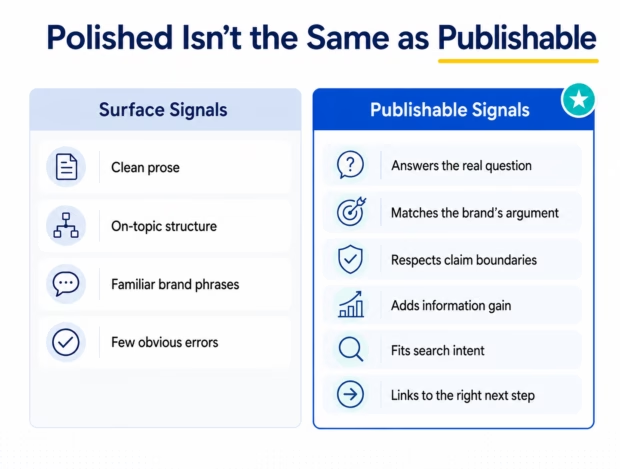
A quality review for outsourced content work should cover:
- Drift from the brief: Did the writer answer the question you asked or a more general one?
- Voice mimicry vs. voice match: Does it sound like you or like a writer imitating you?
- Source-handling habits: Are the sources real, current, and used the way your standards require?
- Claim boundaries: Did the writer make claims your business hasn’t approved?
- Originality and information gain: Is the piece adding something or averaging what already ranks?
- Search intent fit: Does the structure serve the reader or just check keyword boxes?
- Internal-link logic: Are the links the writer chose actually the right next step?
- Polish that hides weakness: Is the article clean but vague or accurate but unhelpful?
That last one is the trap. An outsourced writer who’s a strong stylist can produce drafts that read well and say nothing in much the same way that lazy AI production can. Polished prose is table stakes in 2026. Typos and small errors from a strong writer are easy to fix on the back end. The harder problems are vagueness, drift, and dullness. Those are fixable, but only if your review process is actually looking for them.
What AI changes about the outsourcing decision
AI changes the model, not the need for strong input and review. Treat AI and AI-powered content platforms as a fourth production option alongside in-house, freelance, and provider models, not a shortcut around strategy.
A useful checklist for evaluating AI content production:
- AI production fit: Does the work suit AI’s strengths or expose its weaknesses?
- Input quality: Are the briefs, sources, and rules good enough to drive a good draft?
- Prompts and briefs: Is there an actual system or one-off prompting?
- Human review: Who’s responsible for catching what the tool missed?
- Brand standards: Are they encoded in the workflow or sitting in a doc no one reads?
- Search guidance: Is the system aligned with current search expectations, not yesterday’s tactics?
- Workflow ownership: Whose job is it when the system drifts?
- Provider support: If you didn’t build it, who maintains it?
AI as a production option
AI helps teams produce outlines, first drafts, summaries, repurposed content, and structured editorial checks faster. Using AI doesn’t grant special search advantages; AI-assisted drafts still need to be useful, helpful, original, and aligned with E-E-A-T.
AI as a workflow layer
AI also supports parts of a human-led workflow: brief development, source organization, outline checks, draft QA, internal-link suggestions, and consistency review. Even strong automation needs strong inputs: prompt rules, brand standards, review criteria, and human accountability. Today’s tools move fast, but you may not know if they’re moving in the right direction.
When outside support still matters
Outside support still matters when your team doesn’t have the time or expertise to build, manage, and audit the workflow. Provider-built AI processes are a viable model for teams that want the efficiency without creating new internal roles to keep the system from producing low-value content at scale.
The useful question isn’t whether AI belongs in the process. It’s whether your team can control the inputs, review the outputs, and own the standard for what gets published.
FAQ: outsourcing blog writing
How much does it cost to outsource blog writing?
The cost to outsource blog writing ranges from pennies per article for single-prompt AI output to several thousand dollars for fully human, SME-reviewed thought leadership. The realistic middle for most providers is $100 to $300 for a written and edited 1,000-word article. When you compare options, look past the per-word rate to what’s actually included: writer sourcing, editing, QA, revisions, and deadline management can shift the value of a quote significantly.
Is outsourcing blog writing bad for SEO?
Outsourcing blog writing is not inherently bad for SEO. The risk isn’t outsourcing itself. It’s low-value content, weak intent alignment, thin originality, poor source handling, or content created mainly to satisfy a keyword. Outsourced blog content supports SEO when it’s useful, accurate, original enough to add value, and aligned with reader intent.
How do you keep outsourced blog content on-brand?
To keep outsourced blog content on-brand, give the writer clear voice guidance, audience context, approved claims, examples, source standards, and feedback. The draft isn’t where the writer should be learning how your brand thinks.
Can you outsource technical or niche blog writing?
You can outsource technical or niche blog writing, but the model matters. Technical or niche content needs stronger briefing, better writer matching, subject-matter review, and clearer source rules. A readable draft still needs technical accuracy and audience credibility.
Can I use ChatGPT to write content?
You can use ChatGPT to write some content, but for content that’s expected to compete on the SERP, represent your brand, or carry real subject expertise, not without a workflow around it. A single prompt to a general-purpose model produces the same polish-that-hides-weakness content everyone using AI poorly is publishing. AI is a viable production option when the inputs, brand standards, source rules, and review process are strong enough to make the output worth publishing.