


Human-led, AI-assisted content is the only viable strategy for businesses that want to stay competitive in an increasingly AI-driven content landscape. Right now, boardrooms and marketing teams are stuck in a polarized debate that misses the point.
On one side are the efficiency absolutists. They look at artificial intelligence and see a magic button that replaces the marketing department, slashes the budget, eliminates overhead, and floods the internet with technically accurate text.
On the other side are the purists, who believe using an algorithm is a betrayal of the craft, a one-way ticket to a Google penalty, or a guaranteed way to alienate an audience.
Both sides are wrong.
Budget setters and marketers have always cared about cost optimization, but in a post-AI economy, they expect even more savings. Ignoring the efficiency gains AI can offer is financially irresponsible.
From a strategic standpoint, ignoring the need for human guidance is just as risky. The internet is already filling up with AI slop. It looks polished, answers questions quickly, and checks all the structural boxes, but it often lacks the perspective and personality that come from a real person.
So, should you go all-in on human-only content or spend your time finding the most effective way to type “Write a blog post about…”?
There’s a better option. Human-led, AI-assisted content is a workflow where a skilled writer uses an LLM for research, structure, and drafting then refines the output into something better than either could produce alone.
How human-led content differs from AI-generated content
The gap between human-led and AI-generated content isn’t about whether you use AI. It’s about when it shows up in the process, what it’s allowed to decide, and who’s ultimately accountable for the result.
AI-generated content
This is the “prompt and pray” method. Someone — often not a trained writer — drops a keyword or title into a tool, maybe adds a couple of follow-up prompts, and treats whatever comes back as a draft. Because LLMs are built to find the path of least resistance to “good enough,” you end up with a consensus take stitched together from what’s already on the internet.
It tends to sound like everything else in your niche. The AI leans on whatever habit is trending that month: overstuffed em dashes, verbs like “delve” and “embark,” and entire sections wandering off into unnecessary philosophical ethics about something as simple as unclogging a toilet.
It’s technically correct, structurally tidy, and instantly forgettable.
Surveys show that more than half of Americans are more concerned than excited about the rise of AI. When those readers land on a page that clearly reads as “AI first, human maybe,” trust evaporates quickly.
You might think your multi-prompt workflow saves you here, but it doesn’t if no one is actually leading the tool. If a writer or marketer isn’t interrogating the output, challenging its assumptions, and reshaping it around the brand’s real point of view, it’s still just AI-generated content.
Human-led content
Human-led content starts before a single word is generated. A skilled writer or content lead defines the angle, audience, voice, tone, and key points upfront. They decide what the piece should say (and what it shouldn’t) long before they ask an LLM to write.
AI is then used deliberately to:
- Accelerate research
- Explore options for structure
- Generate outlines
- Organize user thoughts and resource inputs
- Draft specific sections
The writer treats the model as a collaborator, not an autopilot, and uses targeted prompts and constraints to push it away from the default “path of least resistance” answer.
They refine the draft for clarity, accuracy, and especially voice, adding examples, nuance, and personality that AI can’t reliably produce on its own.
At scale, a true human-led, AI-assisted process relies on shared prompt sets, checkpoints, and reviewers. Those guardrails keep drafts consistent, push the AI toward real information gain, and ensure humans remain responsible for judgment calls while the tool handles the heavy lifting.
The benefits of human-led, AI-assisted content
Hybrid workflows succeed because they stop trying to make humans type faster and LLMs better at “feeling.” Each does what it’s good at, in the right part of the process.
Human insights
Large language models are powerful pattern recognizers, not substitutes for a defined point of view. Left to their own devices, they tend to recreate a compressed version of what’s already out there — polished, but flat, homogeneous, and often missing a clear perspective.
A human-led AI writing process injects the missing layer: thought leadership, context, and brand-specific opinion. The writer makes sure the model is writing with your worldview in mind, steering it toward angles, examples, and stances that reflect what your company actually believes and away from generic takes that could belong to anyone in your industry.
Improved efficiency and scalability
Hybrid workflows do save time, but the value is in where that time comes from. Efficiency shows up at several points in the process:
- Research support. AI quickly surfaces relevant sources, examples, and data so the writer spends less time hunting and more time thinking.
- Structure and outlining. AI can turn loose notes into a logical outline so the writer moves past the blank page and into real drafting.
- Brain-dump wordsmithing. After a writer gets ideas out in rough form, AI can suggest cleaner phrasing and alternate angles that the writer accepts, rejects, or rewrites. Non-writers might be surprised at how much time is lost trying to figure out the best way to articulate a thought.
- Revision shortcuts. AI can flag gaps, repetition, or unclear sections so the writer can focus their editing time where it matters most.
- Repurposing and formatting. From one strong core piece, AI can generate working drafts for emails, landing pages, or social posts that the writer then tunes for each channel.
Taken together, these efficiencies compress production time enough that one strong writer can handle work that used to require a small team. That gives you real scalability without burning people out or building a new roster of freelancers every time you need to increase volume.
Greater ROI
Budget setters really care about this metric. Top-shelf human writing is expensive and compelling. Pure AI writing is cheap but often ineffective, if not detrimental.
Human-led, AI-assisted content provides the cost optimization stakeholders now demand without sacrificing the quality required to engage your audience and drive results. It strikes a balance between efficiency and effectiveness that neither approach offers on its own.
Twofold factual accuracy
The tendency of AI models to confidently state things that aren’t true is a real risk. But human writers have been making factual errors for as long as we’ve been publishing anything at all.
A strong human-led workflow adds a twofold defense. Writers verify what the AI produces, and AI helps verify what writers draft by checking claims against available evidence and surfacing contradictions or likely errors.
Done correctly, human-led, AI-assisted content can result in fewer factual mistakes than either might produce independently.
Consistency
As content volume grows, keeping everything aligned gets harder. A human-led, AI-assisted workflow uses shared prompt sets to keep key elements consistent across writers and pieces.
AI can help enforce consistency in areas like:
- Structure and flow: Standardized outlines, required sections, and logical order.
- Formatting: Headings, subheadings, lists, and length guidelines.
- Compliance and guardrails: Required disclaimers, regulated language, and topics to avoid.
- Terminology and naming: Product names, feature labels, internal acronyms, and preferred terms.
- SEO basics: Core keywords, related terms, internal links, and metadata requirements.
- Brand perspective: Clear positions on recurring industry topics so different writers do not contradict each other.
Writers still bring the judgment and nuance, but the system keeps everyone building within the same frame.
Search performance
Search engines are getting better at rewarding content that’s useful and clearly grounded in reality. AI can quickly help you map the topic, organize the page, and identify gaps in what competitors cover.
Human writers then anchor that structure in real context, accurate details, and examples that actually reflect your customers and your experience. That combination tends to perform better over time than AI-only content that leans on generic or invented stories.
The pitfalls of sole reliance on people or AI
So, why does sole reliance on people or AI fail in the current market?
The problem with pure AI
A common misconception is that a great prompt eliminates the need for a skilled human. Even with a sophisticated multi-prompt system, if no one with real content and brand expertise is reviewing the output, you end up with content that is off-message or misaligned with your audience.
Substance is rarely the only issue. Trust is the real problem. Recent data from the Edelman Trust Barometer suggests that consumer trust in AI-generated content is at a low point. When readers sense that something was written by a machine, their confidence in the message drops quickly. It’s not AI detectors you need to worry about; it’s human ones.
In a healthy workflow, someone who understands your brand, your audience, and content best-practices leads the process. If they cannot evaluate whether an output aligns with your strategy, your standards, and your story, AI is not going to fix that gap.
The problem with pure human writing
We need to stop romanticizing human writing. People tend to view human-written as a synonym for high quality, while viewing AI as low quality. That’s false.
Subpar writers have peppered the industry with lackluster writing for decades. Human writing only served as the gold standard when businesses hired skilled, experienced writers. A tired, underpaid, distracted, or inexperienced human writer produces content riddled with errors. It lacks structure, doesn’t feel cohesive, misses nuance, and compels the reader to do nothing else but bounce.
Economics also weigh down the human-only model, which moves slowly and can cost a fortune. Scaling it requires massive operational overhead.
Key tips for human-led, AI-assisted content
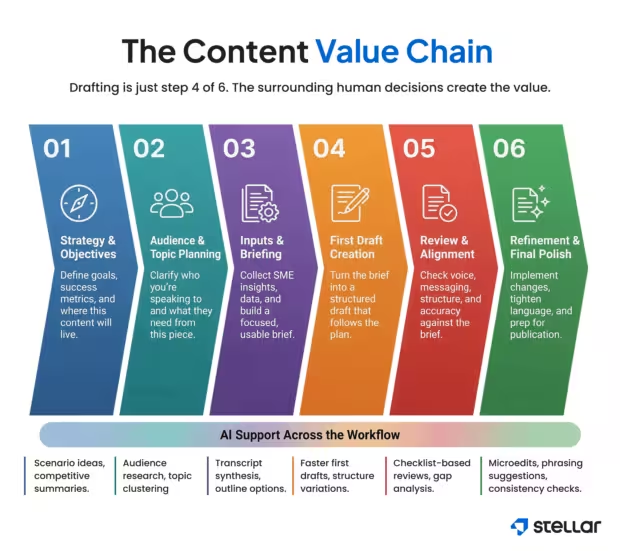
Adopting the human-led, AI-assisted content model requires a shift in mindset. You stop viewing content creation as word generation and start viewing it as strategic assembly.
Getting a first draft is now faster and cheaper than ever, which means pre-draft strategy and post-draft refinement matter more than they have before.
Train your writers; don’t replace them
A common mistake companies make is drastically reducing the writing team and telling the few people left to “just use AI,” as if the tool will let them produce the same volume with the same quality. Sometimes it’s even worse: Writers and content strategists get pushed out of the production process entirely, which opens the door to basic content marketing mistakes and missed opportunities.
Instead, get clear on how your business will use AI in content production.
Is it freeform use inside each writer’s workflow, with the writer accountable for angle, facts, and voice? Or is it a prompt-driven system where writers work inside shared templates and constraints?
Either can work, but only if you train the process. AI doesn’t replace a team. It changes where your team spends its time.
Some things to train writers on (freeform or prompt-driven)
- Basic hygiene: Remove tracking junk like the ChatGPT add-on from any URLs you pull, and always validate that links point to the original source page.
- Current AI telltales: Spot and remove the habits that tip readers off.
- Human-led vs. AI-generated: In a prompt-driven process, the writer’s guidance is the critical ingredient. The prompts don’t create the point of view. The writer does, so show them where it counts most.
- How to handle drift: When the model wanders, don’t follow it. Long threads will continue to drift. In models that allow it, branch into a clean thread. Otherwise, start a new thread from scratch.
- Ground rules for freeform use: Define what must be decided by the writer before prompting (angle, audience, stance, key takeaways, sources) and what must be verified after (facts, links, examples, brand voice).
- What each prompt is meant to accomplish: Writers should know the purpose of each step in a prompt-driven process (topic map, research, structure, outline, section draft, revision pass, fact-check pass) and what to watch for (hallucinated specifics, unearned certainty, soft contradictions, fake citations, shallow angles) in the pre-draft outputs.
- What’s not acceptable in freeform: One-prompt “full article” outputs, unverified stats, invented anecdotes, or publishing anything that hasn’t been reshaped into the brand’s voice and point of view.
- Teach the brain-dump approach: Writers’ thoughts and insights are what make content human-led. The efficiency win is letting them dump ideas in rough, stream-of-consciousness form, then using AI for the first-pass wordsmithing. Good writers can lose a lot of time polishing sentences too early. They don’t have to anymore.
And don’t confuse prompting with writing. Someone who doesn’t understand narrative arc, tone, persuasion, or your industry can’t lead the work. Your best writers are still your best asset. AI just helps them move faster through research, get past blank-page friction, and draft with less wasted motion. Their value is in human judgment and finishing touches: shaping the stance, choosing what to emphasize, and making the message sound like your brand.
Freeform AI can work with one or two trusted writers who truly know your voice and your audience. If you’re producing at volume, shared prompt sets and checkpoints matter. They keep the process consistent while leaving the critical decisions in human hands.
Update your style guide for AI-assisted writing
Your brand voice guide needs an update, but not because AI is the enemy. It needs an update because AI makes it easier than ever to publish content that’s technically “fine” but completely vanilla.
A modern style guide should do more than say “be professional.” It should spell out what “good” looks like when the default draft drifts toward generic. That means defining your point of view, calling out the patterns you don’t want, and setting standards writers are responsible for hitting.
One approach we use at Stellar is a writer resource doc that sits next to the style guide. It does a few things a traditional voice guide rarely does well:
- Captures our perspective on common industry topics so writers aren’t guessing what the brand believes
- Keeps a running list of current AI telltales to avoid, since those habits shift over time
- Shows ways to find real information gain, like looking for conflicting opinions, tradeoffs, edge cases, and angles competitors keep skipping
- Sets a non-negotiable standard: every piece needs a position. If it doesn’t have an opinion, it isn’t finished
Without this, AI writes in the industry’s average voice. With it, AI drafts inside your worldview.
A guide like this only matters if it’s enforced. Bake it into your shared prompts, checkpoints, and reviews so writers aren’t relying on memory or personal preference to keep content on-brand.
Audit your content for information gain and brand fingerprint
Regularly audit your AI-assisted articles. Do they feel AI-generated? Can you point to a real perspective or a contrasting opinion in each one, or is it just a clean summary of what everyone already agrees on?
A quick gut-check:
- What did we add that a competitor (or an LLM) wouldn’t?
- What’s the stance or tradeoff we’re actually taking?
- What proof from our real experience supports the main point?
Don’t rely on the LLM to handle E-E-A-T for you. The real “human-led” ingredient is your company’s lived knowledge. In most organizations, many people can wear an SME tag for at least part of the work you do. Use that.
Conduct short, repeatable interviews on common industry topics with the people on the front lines. Record them. Then build a repository your writers can pull from and your AI tools can reference during outlining and drafting.
Do the same with your case studies. Convert them into structured inputs an LLM can actually use, so it can surface relevant examples without inventing new ones. When you audit your content, you should see that brand fingerprint every time: specific insights, real tradeoffs, and proof that the piece came from your experience, not the internet’s average opinion.
Don’t obsess over AI detectors
Search engines don’t penalize content simply because it’s AI-generated. What gets punished is content that doesn’t deliver: thin, generic pages that don’t help the reader, don’t earn trust, or don’t add anything new.
If the content is valuable, it won’t matter to your audience (or your performance) whether AI helped generate an early draft. Context and substance are what count.
When you’re producing human-led, AI-assisted content, you typically have two paths for the final outcome:
- Editorial humanization: A skilled writer or editor reviews the draft for flow, logic, brand voice alignment, and fact-checking. The goal is to remove the AI habits that quietly erode credibility and to sharpen the piece into something that sounds like a real brand with a point of view.
- Full human rewrite: If internal policies or stakeholder preferences require a fully human-authored read, a writer can rewrite the AI draft in their own words while keeping the structure and meaning. It costs more than an editorial pass, but it’s still faster and less expensive than writing from scratch.
The human element is still the differentiator
AI has made content abundant. When everyone can publish quickly, what creates value is the part that can’t be automated: real insight, real judgment, and a voice people actually want to read.
That’s why human-led, AI-assisted content is the future. It keeps the human element in the driver’s seat while using AI where it’s genuinely useful. You get better outcomes than the pre-AI model because writers spend less time on busywork and more time on thinking, research, and craft. You also get better outcomes than AI-only content because the work carries a point of view, real experience, and accountability.
This is the rare win-win in marketing: higher quality and higher efficiency. The teams that figure out this workflow now will outproduce and outrank the ones still arguing about whether AI belongs in the process at all.
If you want help building and running a human-led, AI-assisted content engine, our managed services team can help.